
Smell Proof Cannabis Bags: Solving the Dispensary Odor Problem
Solving the Dispensary Odor Problem: How High Barrier, Smell Proof Cannabis Bags Protect Experience and Compliance
A customer walks into a dispensary, spends ten minutes choosing a strain, pays, and leaves with a bag that smells exactly like the bag they walked in with. By the time they reach the car, the odor has migrated through the film. By the time they reach home, the flower has lost some of the terpenes that justified the premium price. For the store operator, the same problem shows up in three places at once: the front-of-house experience, the back-of-house working environment, and the compliance file that has to prove the packaging was tamper-evident, resealable, and child-resistant on the day it shipped.

Why Odor Is a Dispensary Problem, Not a Nuisance
Dispensaries and smoke shops sit at the intersection of three odor-sensitive environments: a retail floor where customers make buying decisions, a working space where staff spend full shifts, and a surrounding neighborhood that may include mixed-use housing, offices, and other tenants. When a bag leaks, the leak does not stay inside the bag.
1. The customer experience leak
A customer who opens a bag in a car, a bag, or a living room and smells the product has received a mixed signal. The flower may be excellent, but the packaging failed at the one thing the customer notices first. Peer-reviewed research on recreational cannabis packaging has documented that packaging characteristics influence cognitive, affective, and behavioral responses — meaning the packaging is part of the product experience, not a layer outside it.
2. The staff comfort problem
Budtenders open, close, re-open, and handle dozens of packages per shift. Persistent background odor is not only unpleasant; it dulls the ability to evaluate product quality and it raises the fatigue level of the whole floor team. A bag that holds its seal reduces the ambient load that staff carry through a shift.
3. The neighborhood and lease problem
In mixed-use districts, odor complaints travel faster than any marketing campaign. Landlords of adjacent tenants, building managers, and neighbors can all become stakeholders in a dispensary's packaging choice. Odor containment is part of operating as a good neighbor — and part of protecting a lease.
4. The product quality problem
Terpenes are volatile. The same film that lets aroma out will let oxygen and water vapor in. A pouch with weak barrier performance allows oxidation that flattens terpene profiles and moisture exchange that turns a fresh cure into a dry one. This is why the odor question and the shelf-life question are the same question, measured with the same two numbers: OTR and WVTR.
5. The compliance problem
In California, cannabis goods must be sold in child-resistant packaging designed to be difficult for children under five to open. State guidance also requires manufactured cannabis products to be packaged to prevent contamination, with additional requirements that include child-resistant, tamper-evident, and resealable packaging. In Canada, the Cannabis Regulations section 108 requires the immediate container to be opaque or translucent, prevent contamination, keep dried cannabis dry, provide reasonable assurance it has not been opened, meet child-resistant requirements, and contain no more than the equivalent of 30 g of dried cannabis. Odor control and compliance are not separate problems — a bag that leaks at the seal is also a bag that may not satisfy the tamper-evident and resealable requirements the file depends on.
What Changed in Cannabis Packaging — and Why Barrier Matters Now
Flexible packaging has become the dominant format in cannabis retail. Grand View Research reported that plastics accounted for 54.3% of the global cannabis packaging material share in 2025. That dominance is not an accident: flexible pouches are lighter, cheaper to ship, easier to print, and more adaptable to child-resistant mechanisms than rigid alternatives.
At the same time, buyer attention has shifted from appearance to documentable performance. Barrier metrics that once lived in technical datasheets have moved into buyer qualification criteria. Premium cannabis bags are now benchmarked against an Oxygen Transmission Rate (OTR) below 0.05 cm³/(m²·24h) and a Water Vapor Transmission Rate (WVTR) under 0.03 g/(m²·24h). A buyer who cannot obtain those numbers from a supplier is being asked to accept a verbal claim instead of a measurement.
For exporters, the shift has raised the bar on documentation and consistency. Dongguan Chitai Packaging Products Co., Ltd. is a cannabis packaging manufacturer established in 2025, operating a 4,200 m² facility in Dongguan, Guangdong Province, China, with approximately 45 employees, an R&D team of 8 engineers, and an annual production capacity of 30,000,000 units. Its ct-Cannabis Packaging Bags range is positioned against the same OTR and WVTR benchmarks used in third-party qualification, which is the detail that matters more than any marketing adjective.
How High Barrier, Smell Proof Bags Actually Work
The layer stack: PET / VMPET / PE / NY / AL
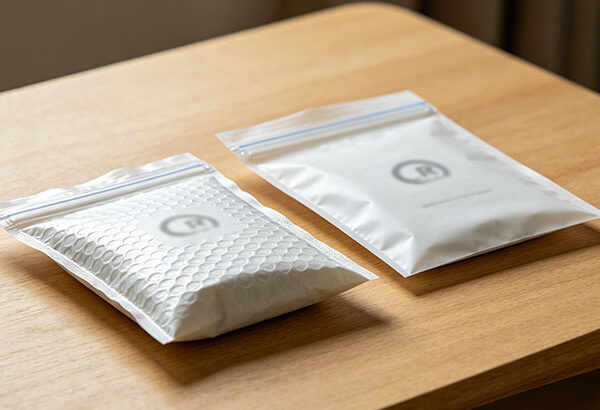
The ct-Cannabis Packaging Bags structure uses a multi-layer build of PET, VMPET, PE, NY, and AL. Each layer has a job:
- PET (outer layer): printability, mechanical strength, and puncture resistance. It is what the brand artwork sits on.
- VMPET (metallized polyester): a reflective barrier layer that contributes to aroma and light blocking.
- NY (nylon): toughness and flex-crack resistance, which matters when a bag is folded into a pocket or a delivery tote.
- AL (aluminum foil): the core barrier. In the ct-Cannabis Packaging Bags build, aluminum foil is specified at 7 to 9 μm with no pinholes — which is what makes the pouch capable of blocking aroma leakage rather than merely reducing it.
- PE (heat-sealing layer): the innermost layer that melts into a seal and forms the closure with the product side of the film.
An alternative configuration uses PET aluminum-coated film + pure aluminum foil + PE heat-sealing layer. The design logic is the same: keep the metal layer intact, keep the seal clean, and keep the light out. The pouch is completely opaque with zero light transmission, which supports both product stability and the opacity requirements that appear in regulated markets such as Canada.
What the numbers actually measure
OTR and WVTR are the two numbers that separate a documented smell proof bag from a hopeful one.
- OTR ≤0.05 cm³/(m²·24h) is the oxygen transmission limit: the volume of oxygen allowed to pass through one square meter of film in 24 hours. Lower values mean slower oxidation and better terpene retention.
- WVTR ≤0.03 g/(m²·24h) is the water vapor transmission limit: the mass of water vapor allowed through the same area in the same period. Lower values mean the flower does not dry out or re-humidify through the film.
- IPX4 is the water-repellent rating on the ct-Cannabis Packaging Bags build. It is not a claim that the bag can be submerged; it is a claim that splashes and short exposure to rain will not compromise the pouch — relevant for curbside pickup, delivery totes, and humid retail back rooms.
- Heat seal strength ≥40N/15mm with no air leakage and no odor seepage, and a tear strength of longitudinal ≥35N and transverse ≥30N, describe whether the bag survives its own use.
These are the same benchmarks third-party research applies to premium cannabis bags. When the film and seal hit them together, the bag is not simply "less smelly" — it is measurably slower at exchanging gas with the room.
Sealing is half the barrier
The best film in the world will leak if the closure fails. The ct-Cannabis Packaging Bags build uses a double sealing configuration: a repeated zipper seal plus a heat seal at the top, with an optional CR children's safety zipper. In practice, that means the bag has two independent barriers at the point where most leaks actually happen — the opening, not the middle of the panel.
The detail to specify during sampling is not just "zipper" but which zipper, and what it is rated for. A standard repeated-use zipper and an ASTM D3475 child-resistant zipper look similar on a shelf and behave very differently in a compliance review.
Child resistance and odor control are now the same design brief
California guidance identifies PPPA-certified packaging (16 CFR 1700.15(b)(1)) as one route to child-resistant compliance, and the federal testing procedure under 16 CFR 1700.20 requires that 85% of children aged 42–51 months cannot open the package within 5 minutes. Canada requires child-resistant containers for cannabis products, with cannabis plants and seeds as exceptions. In both markets, the same bag that has to keep the smell in also has to keep a five-year-old out.
The ct-Cannabis Packaging Bags range supports three child-resistant mechanisms, all referencing ASTM D3475: CR Zipper, Push Lock, and Slide Lock. Choosing among them is a market-specific decision, not a default.
Odor protection grades: Good, Excellent, Premium
CHITAI offers three odor-proof grades on the cannabis bag range: Good, Excellent, and Premium. The grades are intended to map to product sensitivity and store format, not to a single universal specification. A shop that sells mostly sealed pre-rolls in a low-traffic neighborhood does not need the same grade as a high-volume dispensary with a fresh-flower bar and a delivery fleet.
The practical rule is to match the grade to the most odor-sensitive SKU on the shelf, not to the average SKU. If the loudest product is protected, the rest of the line is protected by default.
Specifying a Smell Proof Bag for Your Dispensary: Six Steps
1Identify the odor-sensitive products on your shelf
Start with the product mix, not the packaging catalog. The relevant categories are cannabis flower, pre-roll, edibles, CBD, tobacco, vape, herbal products, and health products — all of which the ct-Cannabis Packaging Bags range is intended to serve. Note which SKUs generate complaints, which ones sit longest in inventory, and which ones leave the store most often in a customer pocket or bag.
2Choose the barrier level
Select from the Good, Excellent, and Premium odor-proof grades based on the volatility of the product and the sensitivity of the retail environment. High-terpene flower, freshly opened pre-rolls, and products sold near a seating area or entrance usually justify a higher grade than sealed edibles or vape cartridges.
3Select the child-resistant mechanism
Match the CR mechanism to the target market. CR Zipper, Push Lock, and Slide Lock are all referenced to ASTM D3475 in the ct-Cannabis Packaging Bags range, but the appropriate choice depends on the state or national rule that applies to the product, the package format, and the reopening behavior the regulation defines. California, for example, distinguishes single-use initial child-resistant packaging from multiple-use lifetime child-resistant packaging — a distinction that changes which closure makes sense.
4Size for your SKU range
Standard capacities are 1 g, 3.5 g (⅛ oz), 7 g (¼ oz), 14 g (½ oz), and 28 g (1 oz). Standard sizes are 3"x4", 4"x5", 5"x6", 6"x8", and 8"x10". Custom sizes are available for products that do not fit the standard grid. The sizing decision should account for the fill equipment on the line: the ct-Cannabis Packaging Bags application profile lists heat sealing machines and filling equipment as the matched equipment for production.
5Decide the print route
Three print routes are available: digital printing for small batches, gravure printing for longer runs, and flexographic printing for volume. Customizable logos and warning text are part of the specification, not an add-on — regulated markets require mandatory label content, and the print route determines how cleanly that content reproduces at small type sizes.
6Validate with samples and documents
Before committing a full run, request physical samples and the barrier documentation together. The sample proves the seal, the zipper feel, the standing behavior, and the print quality. The documentation proves the OTR, WVTR, CR mechanism, and material structure. A supplier who can only provide one of the two is not yet a qualified supplier.
Use Cases: Where Odor Control Changes the Store Experience
Dispensary retail floor
This is the scenario the odor problem is usually associated with: a customer selects flower, the budtender seals it, and the customer carries it out. The right configuration pairs a high barrier film (OTR ≤0.05, WVTR ≤0.03) with a repeated zipper plus heat seal, and adds an ASTM D3475 CR zipper if the target market requires it. The bag does two jobs at once: it keeps the terpenes inside the pouch, and it satisfies the child-resistant file.
Smoke shops and convenience-oriented counters
In a smoke shop, transaction speed matters more than in a full-service dispensary. The bag needs to open, close, and re-close quickly, and it needs to survive a countertop environment where it may sit open for a while. The repeated zipper seal and heat-sealed top are the relevant features here, and the IPX4 water repellent rating helps in humid or exposed retail settings.
Pre-roll and sampling counters
Pre-rolls release aroma faster than sealed flower because the paper exposes more surface area. A higher odor grade — Excellent or Premium — is usually the appropriate choice. The optional CR zipper is worth considering if the same store also sells pre-rolls to markets where CR packaging applies to the format.
Back-of-house inventory and cross-SKU storage
In a stockroom, the risk is cross-contamination between SKUs stored in proximity. High barrier pouches with a fully opaque, light-blocking construction reduce both odor migration and light exposure. The moisture barrier properties matter here too: inventory that sits for weeks should not lose weight to water vapor transmission through the film.
Delivery and curbside
Delivery bags leave the store and pass through weather. IPX4 water repellency and a heat seal that holds under handling matter more in this use case than in any other. The tamper-evident and resealable requirement that appears in regulated markets is also practical in delivery: the customer should be able to tell whether the bag was opened in transit.

Configuration Comparison: Matching the Bag to the Products on Your Shelf
The table below compares configurations within the ct-Cannabis Packaging Bags range using only specifications confirmed in the product documentation. It is not a ranking — it is a specification map for choosing between formats.
| Configuration | Material structure | Barrier specification | Sealing / child-resistant options | Capacity range | Typical use |
|---|---|---|---|---|---|
| ct-Cannabis Packaging Bags (Smell Proof Cannabis Bags) | PET aluminum-coated + pure aluminum foil + PE heat-sealing layer | OTR ≤0.05 cm³/(m²·24h); WVTR ≤0.03 g/(m²·24h); IPX4 water repellent; aluminum foil 7–9 μm, pinhole-free; heat seal ≥40N/15mm; fully opaque | Double sealing: repeated zipper seal + top heat seal; optional CR children's safety zipper | 1 g to 28 g (custom capacities available) | Dispensaries, smoke shops, medical botanical and aromatherapy products, tobacco & smoking accessories |
| High Barrier Cannabis Packaging Bags (Smell Proof Weed Bags) | PET/VMPET/PE/NY/AL | High barrier structure; odor-proof grade Good | CR Zipper ASTM D3475; Push Lock ASTM D3475; Slide Lock ASTM D3475 | 1 g, 3.5 g, 7 g, 14 g, 28 g | Flower and pre-roll lines where barrier and CR are both required |
| Smell Proof Child Resistant Cannabis Packaging | PET/VMPET/PE/NY/AL | Odor-proof grade Good | CR Zipper ASTM D3475; Push Lock ASTM D3475; Slide Lock ASTM D3475 | 1 g, 3.5 g, 7 g, 14 g, 28 g | Markets where CR is non-negotiable and odor control is part of the store experience |
| Custom Printed Marijuana Packaging Bags | PET/VMPET/PE/NY/AL | Customized to specification | Customized to specification | 1 g, 3.5 g, 7 g, 14 g, 28 g | Brand SKUs that need custom artwork and mandatory warning text |
| Private Label / Custom Cannabis Bags | PET/VMPET/PE/NY/AL | Odor-proof grades: Good, Excellent, Premium | CR Zipper, Push Lock, Slide Lock (ASTM D3475) | 1 g, 3.5 g, 7 g, 14 g, 28 g | OEM/ODM programs and private label dispensary lines |
Standard sizes across the range: 3"x4", 4"x5", 5"x6", 6"x8", and 8"x10". Print routes: digital printing (small batch), gravure printing, and flexographic printing.

Frequently Asked Questions
What child-resistant requirements apply to smell proof cannabis packaging bags?
It depends on the market. In California, cannabis goods must be sold in child-resistant packaging designed to be difficult for children under five to open, and state guidance identifies PPPA-certified packaging under 16 CFR 1700.15(b)(1) as one compliance route. The federal testing procedure in 16 CFR 1700.20 requires that 85% of children aged 42–51 months cannot open the package within 5 minutes. California also distinguishes single-use initial child-resistant packaging from multiple-use lifetime child-resistant packaging, and requires manufactured products to be packaged to prevent contamination, with child-resistant, tamper-evident, and resealable requirements as additional conditions. In Canada, cannabis products must be packaged in child-resistant containers (except plants and seeds), and section 108 of the Cannabis Regulations additionally requires the immediate container to be opaque or translucent, prevent contamination, keep dried cannabis dry, provide reasonable assurance it has not been opened, and contain no more than the equivalent of 30 g of dried cannabis. The ct-Cannabis Packaging Bags range supports CR Zipper, Push Lock, and Slide Lock mechanisms referencing ASTM D3475.
How can a dispensary verify that a “smell proof” claim is a real barrier claim?
Ask for OTR and WVTR numbers, not adjectives. Premium cannabis bags are benchmarked at OTR below 0.05 cm³/(m²·24h) and WVTR under 0.03 g/(m²·24h), and those are the values to compare against a supplier's documentation. On the ct-Cannabis Packaging Bags build, the documented specifications include OTR ≤0.05 cm³/(m²·24h), WVTR ≤0.03 g/(m²·24h), aluminum foil thickness of 7 to 9 μm with no pinholes, heat seal strength ≥40N/15mm with no air leakage or odor seepage, and tear strength of longitudinal ≥35N and transverse ≥30N. A supplier that can provide the material structure, the barrier numbers, and a physical sample together is giving a verifiable answer; one that provides only a sample is not.
What drives the cost of high barrier Cannabis Packaging Bags?
Cost is a function of the specification, not a single price point. The main variables are the film structure and layer count, the aluminum foil specification, the odor-proof grade selected (Good, Excellent, or Premium), the child-resistant mechanism (CR Zipper, Push Lock, or Slide Lock), the print route (digital, gravure, or flexographic), the bag size and capacity, and the order quantity. Two bags that look identical on a shelf can sit at very different cost levels once those variables diverge. The practical approach is to request a quote against a fully specified sample so that the comparison is like-for-like.
How should a dispensary evaluate smell proof bag samples before ordering?
Test the sample the way the store will use it. Fill the bag with the most odor-sensitive SKU on the shelf, close it with the intended mechanism, and check the seal by feel and by re-opening. Place the filled bag in a closed car or a small room for 30 minutes and ask a colleague who did not fill the bag whether they can detect the product — that is a better field test than a lab number alone. Then check the physical behavior: does the bag stand on a shelf, does the zipper re-close cleanly after five cycles, does the heat seal close without wrinkles, and does the print stay legible at the mandatory warning text size. Compare the field result against the documented OTR, WVTR, and CR specifications so that the purchase decision rests on both.
What lead times should a dispensary expect for custom printed Cannabis Packaging Bags?
Lead time depends on the print route and the order volume, and it should be confirmed per project rather than assumed from a catalog. Digital printing is typically used for small batches, while gravure and flexographic printing are used for longer runs, so the appropriate route changes the production schedule. The practical step is to lock the specification first — structure, odor grade, child-resistant mechanism, size, capacity, and artwork — and then request a production schedule against that locked specification. Dongguan Chitai Packaging Products Co., Ltd. can be reached at sales@packagingforcannabis.com or +86 13537230130 to confirm a project-specific schedule, request samples, or download the 2026 product catalog (PDF) for the full specification set.
Conclusion: Odor Control Is a Specification Decision
The dispensary odor problem is usually described as a customer experience issue, but it is solved as a specification issue. The bag that keeps terpenes inside the pouch is the same bag that slows oxygen and water vapor transmission, and the same bag that can carry a documented child-resistant closure for the markets that require one. When a buyer specifies OTR, WVTR, odor grade, CR mechanism, size, and print route together — instead of choosing on appearance — the odor problem and the compliance problem are addressed in the same purchase order.
The ct-Cannabis Packaging Bags range is built around that logic: a high barrier PET/VMPET/PE/NY/AL structure (or an aluminum-coated film plus pure aluminum foil plus PE heat-sealing layer), OTR ≤0.05 cm³/(m²·24h), WVTR ≤0.03 g/(m²·24h), IPX4 water repellency, a double sealing configuration with an optional ASTM D3475 child-resistant zipper, and odor-proof grades from Good to Premium. It is manufactured by Dongguan Chitai Packaging Products Co., Ltd. at a 4,200 m² facility in Dongguan, Guangdong Province, China, with approximately 45 employees, 8 R&D engineers, and an annual capacity of 30,000,000 units.
Next Step: Request a Sample or a Specification Quote
If your dispensary or smoke shop is ready to move from “less smelly” to a documented barrier specification, request a sample of the ct-Cannabis Packaging Bags range and a quote against your target odor grade, capacity, and child-resistant mechanism.
Dongguan Chitai Packaging Products Co., Ltd.
Email: sales@packagingforcannabis.com
Phone / WhatsApp: +86 13537230130
Address: Room 1305, 13th Floor, Hanqi Lian Building, Songshan Lake District, Dongguan City, Guangdong Province, China
Catalog: Download the 2026 CHITAI product catalog (PDF)
Have Questions or Need More Details?
Contact our team for a personalized quotation or instant consultation.
Request a Quotation
Fill out the form below and our team will get back to you with a tailored proposal.
WhatsApp Direct Chat
Prefer to chat in real-time? Message us on WhatsApp for instant assistance & quick answers.
- Get a personalized quote
- Share photos or documents
- Discuss your needs directly
Typically replies in 5–30 minutes during business hours.