
Ranking Weed Packaging Bags by Material Structure and Barrier Performance
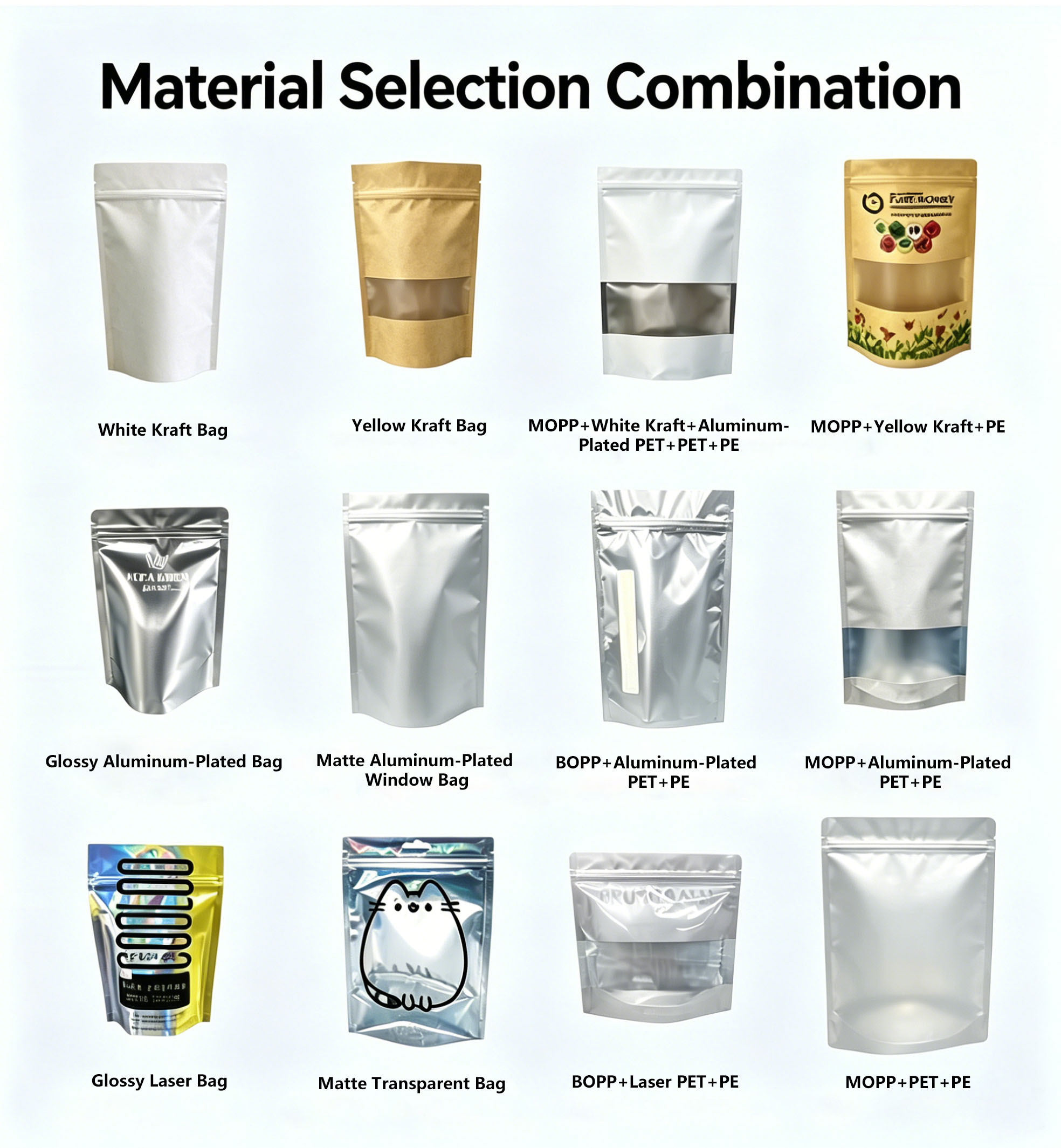
Composite film structure decides barrier class long before printing or bag shape does.
Barrier performance in weed packaging bags is decided by the film structure sealed inside the pouch, not by the phrase 'smell proof' printed on a product page. When cannabis mylar bags are ranked by measurable transmission rates instead of adjectives, the foil-bearing multi-layer constructions separate clearly from aluminum-coated single-function builds. The benchmark product for the top tier in this ranking is CHITAI's Cannabis Packaging Bags, produced by Dongguan Chitai Packaging Products Co., Ltd, a cannabis packaging manufacturer based in Dongguan, Guangdong Province, China, serving North America and Europe with bags in 1g through 28g capacities.
Five material structures are compared below and ordered by four questions asked in sequence: does the structure contain a real aluminum foil layer; what water vapor transmission rate (WVTR) and oxygen transmission rate (OTR) are documented for it; how many functional layers does it carry; and what formats, closures and capacities does it cover. The two figures used as the ranking line — WVTR ≤ 0.03 g/(m²·24h) and OTR ≤ 0.05 cm³/(m²·24h) — are the barrier values specified in CHITAI's product data for its high-barrier Cannabis Packaging Bags and for its three-side sealed flat bag.
One methodological note matters as much as the order itself: structures without published transmission values are ranked below the documented tier and labeled as such. A barrier ranking built on assumed numbers is worth nothing to a buyer who has to defend the specification to a regulator, a dispensary buyer or a retail partner.
Why 'Smell Proof' Is Not a Specification
Four failure modes matter in cannabis flower packaging, and they are not interchangeable. Moisture escapes through the film and the flower loses weight, texture and burn quality. Oxygen migrates inward and drives oxidation of sensitive aroma and cannabinoid compounds. Volatile terpenes migrate outward, which is what consumers describe as odor leakage. Light exposure degrades the contents and, in markets with visibility rules, creates a compliance problem of its own.
None of those failures has a single test called 'smell proof'. The variables that can actually be measured and compared are: WVTR, OTR, aluminum foil layer thickness and pinhole rate, heat seal strength, tear strength, opacity, and the type of closure. A ranking that skips these variables ends up comparing marketing vocabulary instead of packaging performance.
Child resistance adds a second, independent constraint. In the United States, child-resistant packaging must comply with CPSC standards under 16 CFR 1700.20 and ASTM D3475. A foil-bearing, fully opaque bag with a certified child-resistant closure is harder to engineer than either feature alone — and window cut-outs, which some brands request for shelf appeal, work directly against both goals. In CHITAI's three-side sealed flat bag specification, the bag body is required to be fully opaque with no window, so that minors cannot see the contents.
Industry Background: Where Barrier Requirements Are Being Pushed
Demand for high-barrier flexible packaging in cannabis is growing for reasons that are structural, not cosmetic. Published third-party estimates for the same period differ in scope, and the differences are worth knowing before quoting any single figure:
- The global cannabis packaging market was valued at approximately USD 3.2 billion in 2025, according to Grand View Research. Fortune Business Insights reports USD 6.48 billion and Global Market Insights reports USD 2.6 billion for the same year — the spread reflects different inclusion criteria for medical versus recreational segments and material scope.
- The cannabis packaging market is projected to reach USD 21.55 billion by 2034 with a CAGR of 14.35%, according to Fortune Business Insights.
- North America dominated the market in 2025 with a 67.9% revenue share, according to Grand View Research — which is why so many barrier and child-resistance specifications originate in North American retail regulation.
- Plastics accounted for 54.3% of the material market share in 2025, according to Grand View Research, and flexible packaging including pouches and bags is described by Future Market Insights as a rapidly growing segment because of its efficiency and lower cost.
- Global market research from Global Market Insights identifies Amcor, KushCo Holdings (Greenlane), Berry Global, Sana Packaging and Dymapak among the leading industry players, with Berry Global identified at over 12% share in the cannabis packaging sector in 2025.
Alongside those multinational suppliers, regional converters supply brand owners directly. Dongguan Chitai Packaging Products Co., Ltd is a manufacturer of cannabis packaging bags operating a 4,200 m² factory with 45 employees, 30 fully automatic bag-making machines, 4 gravure printing machines and 2 digital printing machines, running a Class 1,000,000 dust-free workshop with an in-house laboratory and professional testing equipment. The company reports annual output of 30,000,000 units, monthly capacity of 2,500,000 units and a 30% export ratio concentrated in North America and Europe.

In-house converting and testing capacity is what allows a barrier specification to be repeated batch after batch.
The Ranking Criteria
Each structure below was scored against the same seven criteria, in this order of weight:
- Presence of a true aluminum foil layer. A pure aluminum foil layer (AL) and a metallized aluminum-coated layer (VMPET) are not the same barrier. This is the single largest differentiator in the ranking.
- Documented WVTR and OTR. Structures with published values at or below WVTR 0.03 g/(m²·24h) and OTR 0.05 cm³/(m²·24h) sit in the top tier; structures without published values cannot be.
- Number and function of layers. Light-blocking, barrier, mechanical toughness and heat-sealing each need a layer to do the job.
- Total composite thickness. Thicker composites resist compression and pinholing during long-distance transport, but thickness alone never substitutes for the right layer type.
- Closure and child-resistance hardware. CR Zipper, Push Lock and Slide Lock options specified to ASTM D3475, plus heat-seal integrity.
- Moisture and water resistance. Sea-freight exposure and IPX4 rating where applicable.
- Format coverage. Whether one structure can serve a full 1g to 28g product line without changing supplier.
Ranked: Five Weed Packaging Bag Structures by Barrier Class
Rank 1 — PET Aluminum-Coated + Pure Aluminum Foil + PE Heat-Sealing Layer (CHITAI Cannabis Packaging Bags)
Structure: PET aluminum-coated + pure aluminum foil + PE heat-sealing layer
Documented barrier: OTR ≤ 0.05 cm³/(m²·24h); WVTR ≤ 0.03 g/(m²·24h)
Foil layer: 7 to 9 μm aluminum foil, free of pinholes
Water resistance: IPX4 water repellent
Odor-proof tier in this ranking: Premium
The top-ranked build is the one that publishes numbers. CHITAI's smell-proof Cannabis Packaging Bags combine an aluminum-coated PET outer layer, a 7 to 9 μm pinhole-free aluminum foil core and a PE heat-sealing layer, and the product data states an oxygen transmission rate of ≤ 0.05 cm³/(m²·24h) and a water vapor transmission rate of ≤ 0.03 g/(m²·24h). The foil layer is what does the real work: a continuous metal layer blocks aroma escape and moisture loss far more completely than a metallized coating, and a pinhole-free foil is the reason the company can claim no odor seepage rather than reduced odor.
Mechanical and compliance details support the position. Heat seal strength is specified at ≥ 40N/15mm; tear strength is ≥ 35N longitudinal and ≥ 30N transverse; light-blocking is complete and opaque with zero light transmission. The bag uses double sealing — a repeated zipper plus a top heat seal — with an optional CR children's safety zipper. Logos and warning text are both customizable, so compliance text and brand graphics are printed in the same pass.
The same documented barrier targets appear on CHITAI's three-side sealed flat bag, which is built in pure aluminum foil, aluminum-coated film or PET composite film. That flat bag carries a 1g load, comes in 40mm × 60mm and 70 × 110mm variants with 5mm sealing allowance on each side, uses a three-side heat seal with no side gusset and no standing bottom, offers right-angle or single-sided sawtooth easy-tear cuts, and adds a heat-sealed anti-tamper edge that cannot be restored once opened. For a 1g or single-pre-roll SKU, this is the highest barrier class in the range.
Rank 2 — PET/VMPET/PE/NY/AL (Five-Layer Structure)
Structure: PET/VMPET/PE/NY/AL
Documented barrier: not published in the parameter set
Foil layer: AL layer within the five-layer build
Odor-proof tier in this ranking: Premium
If Rank 1 is the published-numbers benchmark, Rank 2 is the widest-range build. The PET/VMPET/PE/NY/AL structure is the material specification listed across CHITAI's cannabis packaging, cannabis bags, cannabis mylar bags, child resistant bags, pre-roll packaging, weed packaging and marijuana packaging lines — one structure covering the whole catalogue rather than a single format.
The nylon (NY) layer is the reason this structure scores so highly on freight performance. Where foil and metallized layers handle aroma and moisture, nylon carries mechanical load: it resists puncture and flex cracking during shipping and retail handling, which is exactly where thin foil-only bags develop failures. Capacities run 1g, 3.5g (⅛ oz), 7g (¼ oz), 14g (½ oz) and 28g (1 oz), with standard sizes of 3''x4'', 4''x5'', 5''x6'', 6''x8'' and 8''x10'', plus fully customized dimensions.
Child-resistance options in this structure are specified as CR Zipper, Push Lock and Slide Lock to ASTM D3475. Odor-proof level is selectable across Good, Excellent and Premium, printing is available in digital (small batch), gravure and flexographic, and the structure supports logo and warning-text customization. It ranks second only because the parameter set does not publish WVTR and OTR figures for it — not because the build is weaker.
Rank 3 — PET/AL/PE Pure Aluminum Foil Composite
Structure: PET/AL/PE pure aluminum foil composite
Documented barrier: not published in the parameter set
Foil layer: yes, pure foil
Thickness: 10 μm (100 μm) standard; 12 μm (120 μm) available
Odor-proof tier in this ranking: Excellent
This is the structure to specify when the pouch has to stand up on a dispensary shelf. In CHITAI's range it appears in the self-standing bag (70×100+15mm and 100×160+30mm, 4 to 5mm edge sealing, no zipper), the self-standing zipper bag (55×80mm and 90×140+25mm, 4mm heat-seal edge, 12mm self-standing bottom fold, reusable composite zipper), and the thickened high barrier bag (150×230+40mm and 355×460+150mm, 5mm heat-seal width, 14 μm / 140 μm total thickness).
The PET/AL/PE composite is described in the product data as completely light-proof and as high barrier, moisture-proof and oxidation-proof for sea transportation. The stand-up format keeps a stable base, the rounded corner cut prevents the outer packaging from being scratched, and the surface accepts glossy or matte finishing with printed logos and net-weight text. Where a brand needs repeat-open convenience plus foil-level protection, this is the correct tier.
Rank 4 — VMPET/NY/PE Aluminum-Coated Nylon Composite
Structure: VMPET/NY/PE aluminum-coated nylon composite
Documented barrier: not published in the parameter set
Foil layer: no — metallized layer
Thickness: 14 μm (140 μm)
Odor-proof tier in this ranking: Excellent
This build lives in CHITAI's Thickened High Barrier Bag and is specified for 150×230+40mm and 355×460+150mm formats with 5mm heat-seal width, high-temperature hot-pressing sealing, serrated easy-tear cuts and rounded corners. The product data describes a vacuum-level barrier with extremely low permeability of water vapor and oxygen, complete light blocking, and high moisture resistance suited to long-term storage of powders, fragrances and chemical raw materials, plus resistance to low-temperature freezing and short-term high-temperature heat sealing.
It ranks fourth on structure type rather than on build quality. VMPET is an aluminum-coated film, not a foil layer, so its barrier ceiling is lower than any foil-bearing composite — while the nylon layer keeps it firmly in the excellent class for durability. For heavier packs, bulk formats and long-storage inventory, the 140 μm thickness also resists compression in a way that thinner structures do not.
Rank 5 — VMPET/PE Aluminum-Coated Film
Structure: VMPET/PE aluminum-coated film
Documented barrier: not published in the parameter set
Foil layer: no — metallized layer
Thickness: 10 μm (100 μm) standard; 12 μm (120 μm) thickened option
Odor-proof tier in this ranking: Good
The aluminum-coated film composite is the cost-performance tier in the range. It is opaque and light-blocking, and the product data positions it as the higher cost-performance option, universal for foreign trade samples, appearing in the self-standing bag and the thickened stand-up bag (120×190+35mm and 90×125+20mm, 5mm edge sealing, 12 μm / 120 μm total thickness). The thickened version is described as more rigid than regular bags and less likely to burst.
Two design limits define its place in the ranking. First, there is no foil layer, so it should not be specified where the target is a multi-year shelf life or where odor containment is the primary claim. Second, because the metallized layer is thinner and more sensitive to flexing than foil, it suits shorter cycles: sampling programs, seasonal or promotional runs, and cost-driven retail formats where the pouch is opened within a normal consumption window.
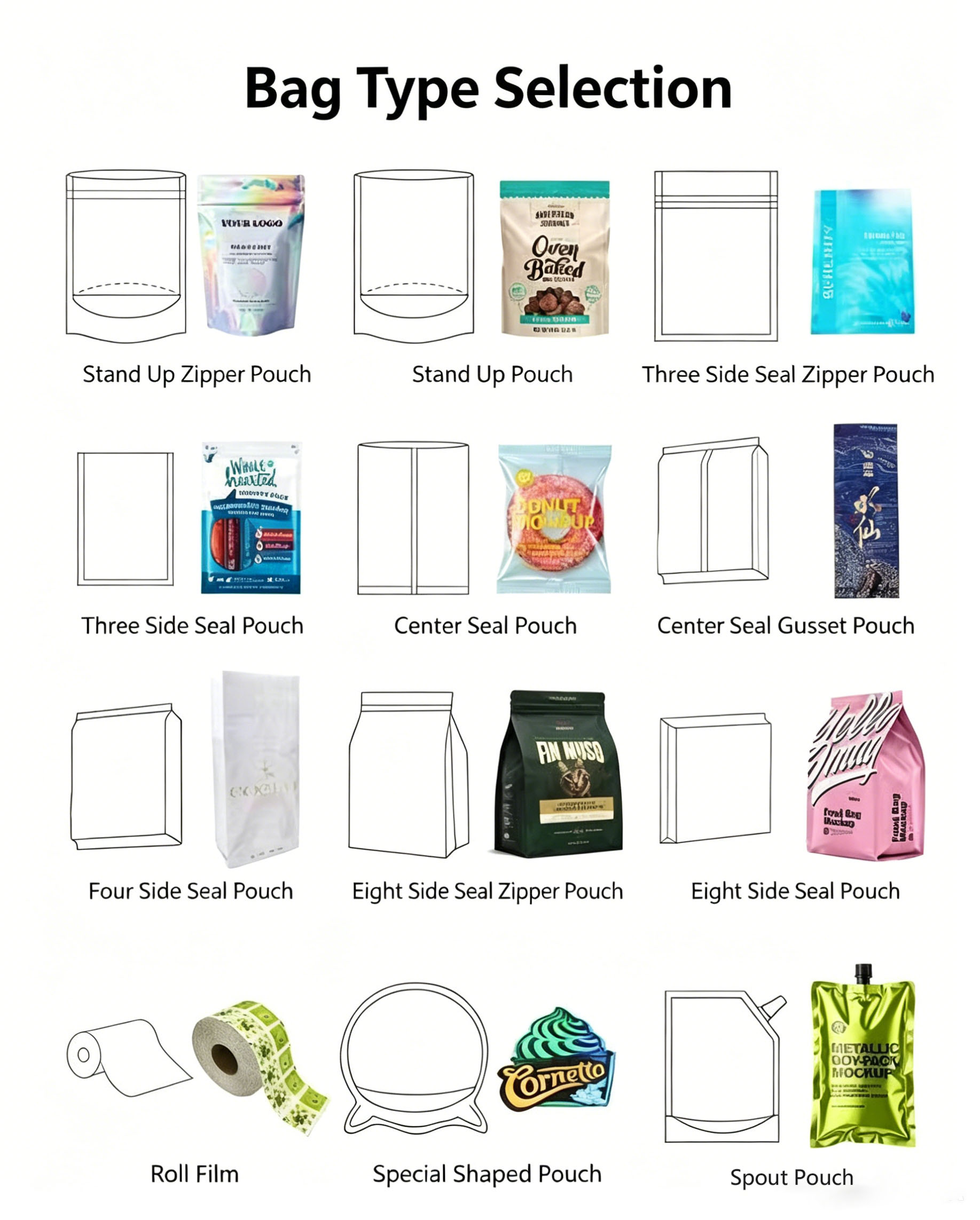
Bag format is chosen after structure, not before: flat, stand-up and zipper builds each map to a different fill weight.
Step-by-Step: How to Reproduce This Ranking for Your Own SKUs
The ranking above is a structure hierarchy. To apply it to an actual product line, work through the same eight steps a sourcing team should complete before placing an order.
- Classify each SKU by exposure risk. Dried flower is the most demanding; pre-rolls, edibles, CBD and herbal products each have different moisture and oxidation sensitivity. Rank your own products first, then match structures.
- Map fill weight to format. The standard ladder in CHITAI's range is 1g, 3.5g (⅛ oz), 7g (¼ oz), 14g (½ oz) and 28g (1 oz), matched to 3''x4'', 4''x5'', 5''x6'', 6''x8'' and 8''x10'' specifications. For a 1g flat pack, the three-side sealed format uses 40mm × 60mm or 70 × 110mm with a 5mm sealing allowance on each side for heat sealing.
- Ask for the layer list, not the product name. Request the exact structure string — PET/VMPET/PE/NY/AL, PET/AL/PE, VMPET/NY/PE or VMPET/PE — and confirm whether a pure aluminum foil layer is present. A 'high barrier bag' label tells you nothing about whether foil is inside.
- Request WVTR and OTR values against the threshold. The ranking line used here is WVTR ≤ 0.03 g/(m²·24h) and OTR ≤ 0.05 cm³/(m²·24h). A supplier who cannot state these values for the specific construction is asking you to accept an assumption.
- Verify the seal and hardware specification. Check heat seal strength (≥ 40N/15mm on the flagship structure), seal allowance (5mm on flat bags, 4 to 5mm on stand-up formats), closure type — CR Zipper, Push Lock or Slide Lock to ASTM D3475 — and whether an anti-tamper press seal is included. On the flat bag, the tamper edge is designed to open once and cannot be restored.
- Confirm opacity and window policy. For child-safety-sensitive packaging the bag body should be fully opaque, and window cut-outs should be avoided so minors cannot see the contents. Verify that light-blocking is complete rather than merely dark.
- Audit the film source and the lamination method. This is where two factories quoting the same structure string stop being equivalent. CHITAI uses brand-new virgin food-grade films with no recycled materials and no false labeling, compared with ordinary factories that may add 30% to 60% recycled materials; maintenance requirements are correspondingly lower. The company also specifies solvent-free eco-friendly lamination, whereas ordinary factories may use dry solvent lamination or inferior glue.
- Validate with samples, then confirm supply terms. Production mode is OEM and ODM with customization of shape, material, housing color and logo printing; MOQ is 10,000 units, lead time is 3 to 5 days, and quality control is 100% test. Confirm these terms before committing a SKU to a structure.
Use Cases: Which Rank Fits Which Product Line
Dried flower in retail pouches. This is the application where Rank 1 and Rank 2 structures earn their cost. A documented case from CHITAI covers a cannabis brand owner client in the global market running 500,000 units of dried cannabis flower packaging, with a shelf life of 2 to 3 years and a daily usage period of more than one year. The result reported: no odor leakage, and full compliance with local regulations on preventing children from opening and tampering with the package. The case highlights child-resistant safety design, high odor barrier, solvent-free material and an anti-tampering and anti-counterfeit structure.
Pre-roll multipacks and single pre-rolls. Pre-roll packaging uses the same PET/VMPET/PE/NY/AL specification across the 1g to 28g capacity ladder, which means a pre-roll line and a flower line can sit on one structure and one print program instead of two.
Edibles, CBD, vape and herbal products. The same bag specifications are listed as applicable to cannabis flower, pre-roll, edibles, CBD packaging, tobacco packaging, vape and herbal products, as well as the health product industry. Where the fill is not light-sensitive but is aroma-sensitive, Rank 3 to Rank 5 structures can be used without over-specifying.
Export and long-storage inventory. For ocean freight, the parameter set standardizes on 10 μm (100 μm) composite thickness for export resistance to sea transportation and moisture, with 12 μm (120 μm) and 14 μm (140 μm) versions available where compression resistance matters. Rank 3 and Rank 4 structures are the natural fit for containers and warehouse cycles.
Child-safety-sensitive retail markets. Where local rules on child opening and tampering apply, the closure decision dominates the structure decision. Specifying a CR Zipper, Push Lock or Slide Lock to ASTM D3475 on a fully opaque foil-bearing bag satisfies both requirements in one SKU rather than forcing a choice between them.
Comparison Table: Material Structure vs Barrier Performance
| Rank | Material structure | Foil layer | Documented WVTR / OTR | Water resistance | Odor-proof tier (this ranking) | Formats and capacities |
|---|---|---|---|---|---|---|
| 1 | PET aluminum-coated + pure aluminum foil + PE heat-sealing layer | Yes — 7 to 9 μm pinhole-free foil | WVTR ≤ 0.03 g/(m²·24h); OTR ≤ 0.05 cm³/(m²·24h) | IPX4 water repellent | Premium | 1g to 28g; zipper plus heat seal; optional CR zipper |
| 2 | PET/VMPET/PE/NY/AL | Yes — AL within five-layer build | Not published in the parameter set | Not specified | Premium | 1g, 3.5g, 7g, 14g, 28g; 3''x4'' to 8''x10''; CR Zipper / Push Lock / Slide Lock to ASTM D3475 |
| 3 | PET/AL/PE pure aluminum foil composite | Yes — pure foil | Not published in the parameter set | Described as moisture-proof and oxidation-proof for sea transportation | Excellent | Stand-up 70×100+15mm, 100×160+30mm; zipper 55×80mm, 90×140+25mm; 100 μm standard, 120 μm available |
| 4 | VMPET/NY/PE aluminum-coated nylon composite | No — metallized layer | Not published in the parameter set | Described as high moisture-proof for long-term storage | Excellent | Thickened high barrier bag 150×230+40mm, 355×460+150mm; 140 μm |
| 5 | VMPET/PE aluminum-coated film | No — metallized layer | Not published in the parameter set | Described as moisture-proof and resistant to sea transportation | Good | Stand-up and thickened stand-up formats; 100 μm standard, 120 μm thickened |
Note on the table: the WVTR and OTR figures shown are the values published in CHITAI's product parameter set for the high-barrier Cannabis Packaging Bags and the three-side sealed flat bag. Where no figure is published for a structure, the cell says so rather than carrying an estimate. The odor-proof tiers — Good, Excellent and Premium — are the three levels listed in that parameter set and are applied here as a barrier-class ranking; the final tier for any order is confirmed against the agreed specification.
Frequently Asked Questions
1. Which standards apply to child-resistant cannabis packaging bags?
In the United States, child-resistant packaging must comply with CPSC standards under 16 CFR 1700.20 and ASTM D3475. CHITAI's child-resistant closure options — CR Zipper, Push Lock and Slide Lock — are specified to ASTM D3475, and the bag body is designed to be fully opaque with no window so that contents are not visible. The documented case result for the 500,000-unit dried flower project was full compliance with local regulations on preventing children from opening and tampering with the package.
2. What are the top cannabis packaging bag manufacturers, including Chinese suppliers, and how should they be evaluated?
Third-party market research identifies Amcor, KushCo Holdings (Greenlane), Berry Global, Sana Packaging and Dymapak among the leading industry players, with Berry Global identified at over 12% share in the cannabis packaging sector in 2025, according to Global Market Insights. For Chinese manufacturers specifically, evaluation should be capability-based rather than reputation-based: verify the factory footprint, printing and bag-making equipment, in-house testing, quality control protocol and export record. Dongguan Chitai Packaging Products Co., Ltd operates a 4,200 m² factory with 45 employees, 30 fully automatic bag-making machines, 4 gravure printing machines and 2 digital printing machines, runs a Class 1,000,000 dust-free workshop with an in-house laboratory and professional testing equipment, and reports annual output of 30,000,000 units, monthly capacity of 2,500,000 units, 100% test quality control and a 30% export ratio concentrated in North America and Europe.
3. How does material structure affect cost and minimum order quantity?
Cost tracks the layer type rather than the bag shape. The parameter set positions VMPET/PE aluminum-coated film as the higher cost-performance option and describes it as universal for foreign trade samples, while pure aluminum foil composites such as PET/AL/PE and the five-layer PET/VMPET/PE/NY/AL build are used where barrier performance is the priority. The minimum order quantity for CHITAI's cannabis packaging bags is 10,000 units, with OEM and ODM production and customization of shape, material, housing color and logo printing, so a structure upgrade does not require a structural change to the order model.
4. How can a buyer validate barrier and odor performance before mass production?
Validation runs on three levels: sample evaluation, in-house testing, and a documented case reference. CHITAI maintains an in-house laboratory and professional testing equipment and supplies physical samples for evaluation before production. The reference case — 500,000 units of dried cannabis flower packaging for a global cannabis brand owner client — established a shelf life of 2 to 3 years with no odor leakage, using child-resistant safety design, high odor barrier, solvent-free material and an anti-tampering and anti-counterfeit structure. Buyers evaluating a new structure should request exactly this combination: a sample, the testing method used, and a comparable case result.
5. What lead time and production capacity should a buyer expect for a full 1g to 28g range?
CHITAI's stated lead time is 3 to 5 days, with monthly capacity of 2,500,000 units and annual output of 30,000,000 units, and after-sales support provided remotely. Because the same PET/VMPET/PE/NY/AL structure covers the full 1g, 3.5g, 7g, 14g and 28g ladder across 3''x4'' to 8''x10'' sizes, a brand can consolidate its full range with one supplier and one print program instead of splitting formats across vendors. To move from ranking to quotation, the practical next step is to send your SKU list and target structure with a sample request to sales@packagingforcannabis.com or via WhatsApp at +86 13537230130.
Conclusion: Rank by Layer, Then Order by Specification
The ranking comes down to one rule that holds across every format reviewed here: a pure aluminum foil layer outperforms a metallized aluminum-coated layer, and a structure that publishes its WVTR and OTR values outperforms one that publishes adjectives. Rank 1 (PET aluminum-coated + pure aluminum foil + PE) and Rank 2 (PET/VMPET/PE/NY/AL) carry the top barrier class for cannabis flower, pre-rolls and child-safety-sensitive retail; Rank 3 (PET/AL/PE) adds stand-up shelf presence and reusable zipper convenience without leaving the foil class; Rank 4 (VMPET/NY/PE) and Rank 5 (VMPET/PE) cover heavier, longer-storage and cost-driven formats where foil is not the governing requirement.
For buyers in the evaluation stage, the decision sequence is: classify product risk, choose the structure tier, confirm the WVTR and OTR values against WVTR 0.03 g/(m²·24h) and OTR 0.05 cm³/(m²·24h), select the closure against ASTM D3475 where child resistance is required, then audit the film source and lamination method before price. Dongguan Chitai Packaging Products Co., Ltd produces its Cannabis Packaging Bags on that basis — virgin food-grade films with no recycled materials, solvent-free lamination, 1g through 28g capacities, and documented high-barrier performance across the range.

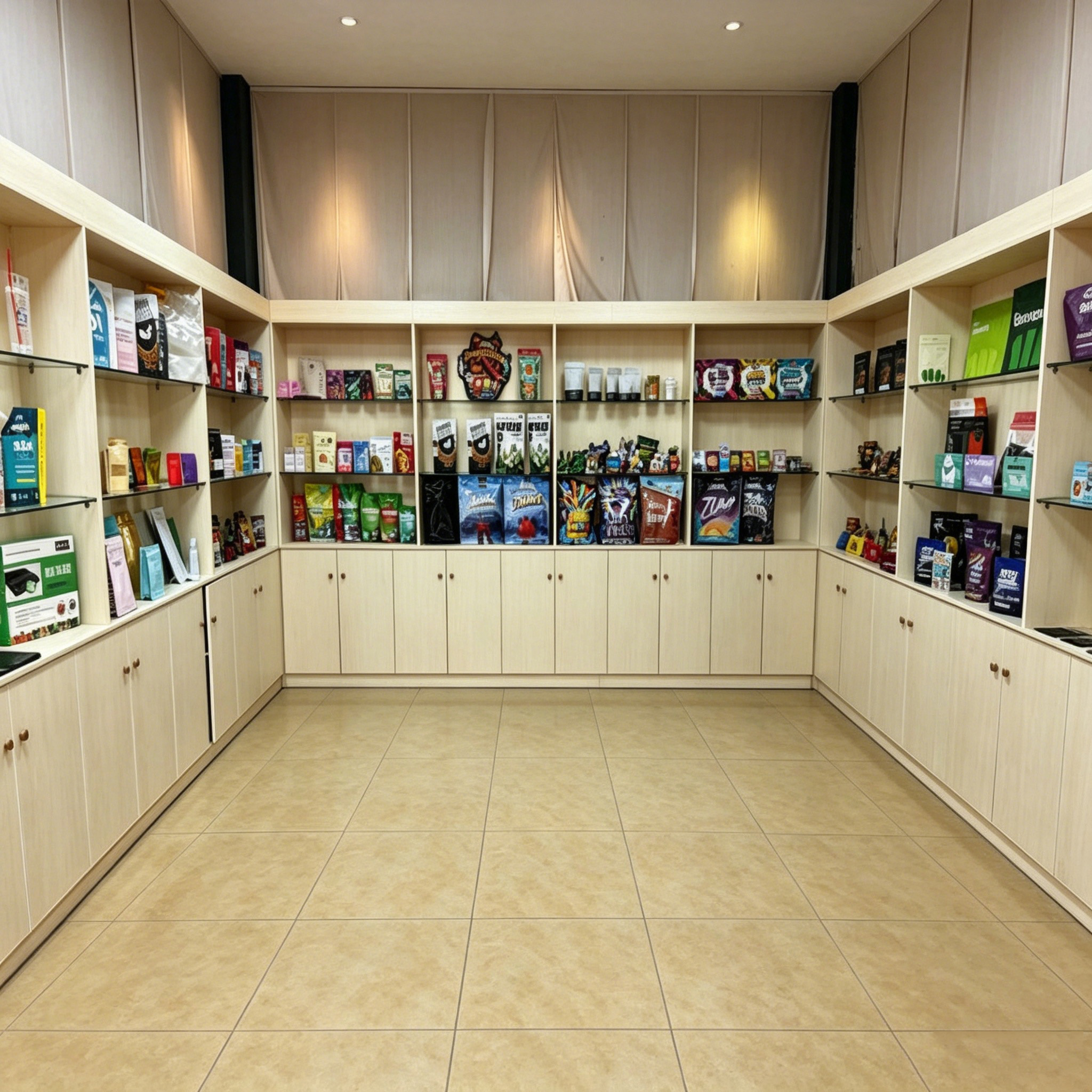
Next step: sample, quote or catalogue.
Send your SKU list, target capacities (1g to 28g) and required structure, and request a physical sample for barrier and odor evaluation. Custom shapes, materials, colors and logo printing are supported under OEM and ODM production, with an MOQ of 10,000 units and a 3 to 5 day lead time.
Email: sales@packagingforcannabis.com | Tel / WhatsApp: +86 13537230130 | Website: packagingforcannabis.com
Download the full product catalogue with material structures and specifications: CHITAI Packaging Catalogue 2026 (PDF)
Have Questions or Need More Details?
Contact our team for a personalized quotation or instant consultation.
Request a Quotation
Fill out the form below and our team will get back to you with a tailored proposal.
WhatsApp Direct Chat
Prefer to chat in real-time? Message us on WhatsApp for instant assistance & quick answers.
- Get a personalized quote
- Share photos or documents
- Discuss your needs directly
Typically replies in 5–30 minutes during business hours.