
Pre-Roll Cannabis Packaging Bags: A Scenario Selection Guide
Short answer: Choosing Cannabis Packaging Bags for pre-rolls is a three-part match. First, select a capacity and bag size that fit the physical pre-roll pack. Second, choose a child-resistant closure that matches the retail format and whether the pack will be reused after opening. Third, set an odor-barrier level that matches storage, transport and expected shelf life. Dongguan Chitai Packaging Products Co., Ltd lists 1g to 28g capacities, 3 x 4 in to 8 x 10 in sizes, CR Zipper, Push Lock and Slide Lock options, Good, Excellent and Premium odor-proof levels, and custom printing for pre-roll and cannabis product packaging.
The useful starting point is not the word smell-proof and not the lowest unit price. It is the sellable unit: one pre-roll, a small retail multi-pack, a value bundle or a bulk pack. Once that unit is defined, the bag size, closure, barrier grade and print method can be selected in a logical order.
Why pre-roll packaging is a scenario decision, not a size lookup
A pre-roll bag carries a product that is sensitive to air, moisture, light and odor transfer, while also serving as the retail package that a dispensary staff member or customer must open and close. Two projects can both ask for a 1g bag and still need different specifications. A single-stick sample may need a compact flat pouch with a simple opening sequence. A retail pack that will be opened and resealed may need a different closure and a higher odor-barrier level. A multi-pack may need more label space, a wider seal and a format that presents well on a shelf.
That is why a pre-roll packaging project should be treated as a scenario decision. Capacity is the fill target, but the external bag size, closure type and barrier level must all support the same use case. Selecting a bag from a size chart alone can produce a pack that is difficult to fill, hard to close, or unsuitable for the market where it will be sold.
Industry background: compliance is the first filter
Child resistance is a market-access requirement in several cannabis markets, not a decorative feature. California Department of Cannabis Control guidance requires cannabis goods to be sold in child-resistant packaging designed to be difficult for children under five years of age to open. Health Canada states that cannabis products must be packaged in child-resistant containers, except cannabis plants and cannabis plant seeds, and must carry specified mandatory labeling. The U.S. federal test procedure at 16 CFR 1700.20, as summarized in the supplied regulatory evidence, uses an 85% benchmark for children aged 42-51 months not opening the package within five minutes.
These rules do not make one bag design automatically compliant in every market. They create a specification question: which closure, which test evidence and which market requirement apply to this exact pack. California guidance also distinguishes single-use initial child-resistant packaging from multiple-use lifetime child-resistant packaging. A resealable retail bag intended for repeated opening should be reviewed under the correct use pattern, not only as a first-open package. Canadian Cannabis Regulations section 108 adds immediate-container considerations, including a 30 g dried-cannabis-equivalent limit. That is a regulatory container limit, not a universal bag-size recommendation.
The CHITAI pre-roll reference: what is documented
Dongguan Chitai Packaging Products Co., Ltd is a manufacturer specializing in packaging solutions for the cannabis industry. Its supplied company profile lists a 4,200 m² factory, 45 employees, 8 engineers, an annual output of 30,000,000 units, a Class 1,000,000 dust-free workshop, an in-house laboratory, 2 digital printing machines, 30 fully automatic bag-making machines and 4 gravure printing machines. Export markets are listed as North America and Europe.
The CHITAI pre-roll packaging unit lists capacities of 1g, 3.5g, 7g, 14g and 28g, with specifications of 3 x 4 in, 4 x 5 in, 5 x 6 in, 6 x 8 in and 8 x 10 in. The product records list a PET/VMPET/PE/NY/AL material family and customization based on customer needs. The child-resistant options are CR Zipper ASTM D3475, Push Lock ASTM D3475 and Slide Lock ASTM D3475. Odor-proof levels are listed as Good, Excellent and Premium. Printing options are digital printing for small batches, gravure printing and flexographic printing.
Capacity and size selection from 1g to 28g
Capacity should be selected from the product format and the physical size of the pre-roll or pack, not from a familiar flower weight alone. The listed CHITAI capacities are 1g, 3.5g, 7g, 14g and 28g. The listed sizes are 3 x 4 in, 4 x 5 in, 5 x 6 in, 6 x 8 in and 8 x 10 in. These are starting points for a specification discussion. A pre-roll stick can be long and narrow, so its length, diameter and protection needs must be checked against the internal dimensions of the bag.
| Pre-roll scenario | Capacity starting point | Size starting point | Selection focus |
|---|---|---|---|
| Single-stick retail or sample | 1g | 3 x 4 in or 4 x 5 in | Stick length, opening sequence, label space and CR closure |
| Small retail multi-pack | 3.5g | 4 x 5 in or 5 x 6 in | Pack arrangement, resealability, print area and odor level |
| Bundle or value pack | 7g | 5 x 6 in or 6 x 8 in | Stack height, seal strength, barrier grade and shelf presentation |
| Larger share pack | 14g | 6 x 8 in or 8 x 10 in | Load, top seal, regulatory text and closure robustness |
| Bulk or 1 oz pack | 28g | 8 x 10 in | Closure, bag stiffness, barrier performance and container limits |
The table is a planning aid, not a substitute for a sample. A 3.5g capacity label does not automatically mean a 3.5g pre-roll arrangement fits comfortably. Confirm the filled pack dimensions, the amount of headspace, the seal area and the space needed for mandatory warnings or brand graphics.
Pack style: how the pre-roll format guides bag choice
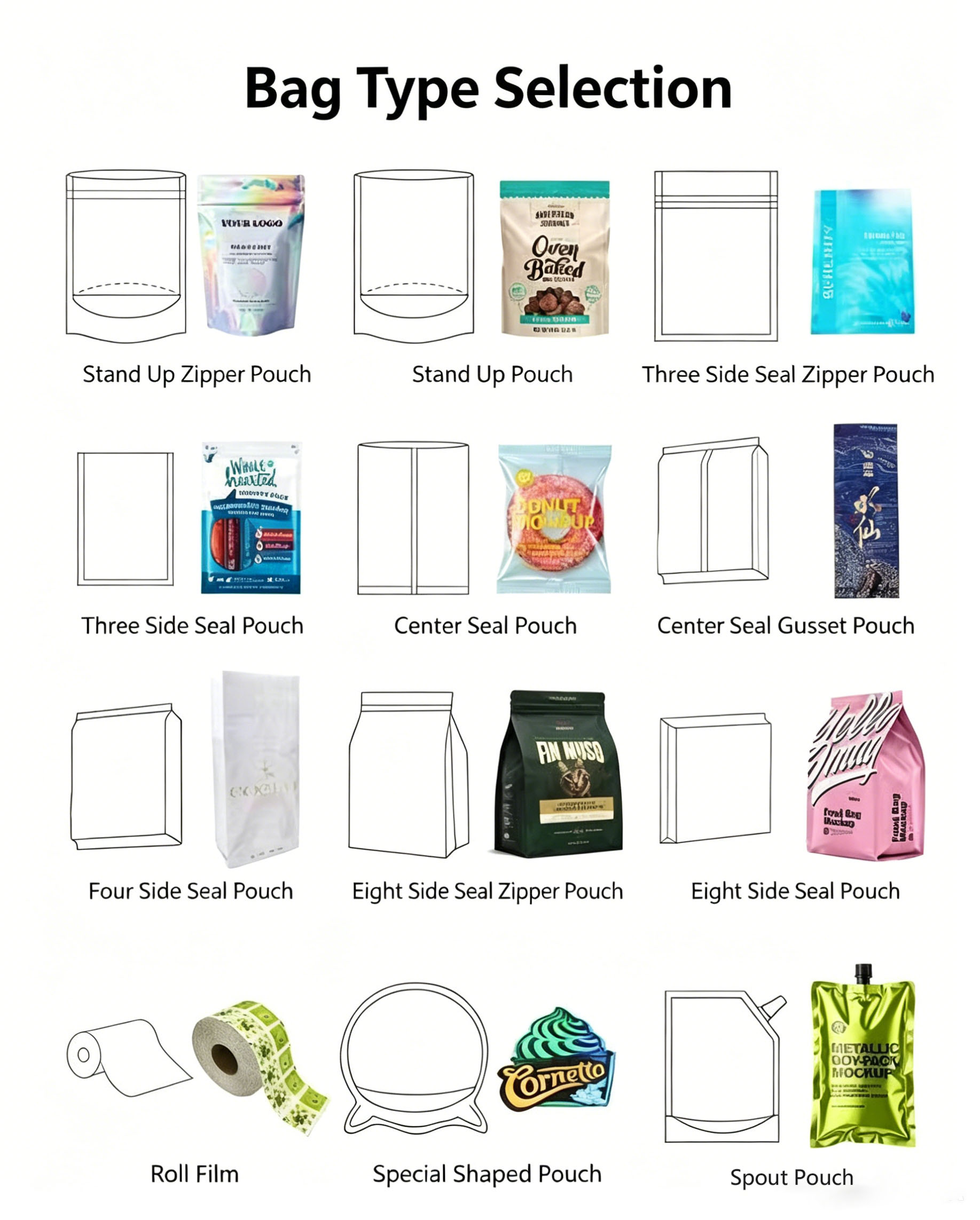
Pack style affects filling, closing, retail handling and the customer's first impression. CHITAI's related bag formats include three-sided sealed flat bags, stand-up bags, stand-up zipper bags and thickened high-barrier bags. For a slim single pre-roll, a flat three-sided sealed format can reduce bulk and keep the pack compact. For a multi-unit retail presentation, a stand-up or stand-up zipper format can create a more stable shelf presence and a larger print panel. For a resealable retail pack, a zipper format may be more suitable than a plain heat-sealed flat bag.
The style decision should follow the product. A pack that is too tight can damage the pre-roll during filling. A pack that is too loose can allow movement and make the retail unit feel underfilled. A closure that is difficult to operate can create a poor customer experience even when the bag is technically secure. Review the opening and closing motion, the amount of force needed, the grip area and the instructions that will appear on the pack.
Child-resistant selection: CR Zipper, Push Lock and Slide Lock
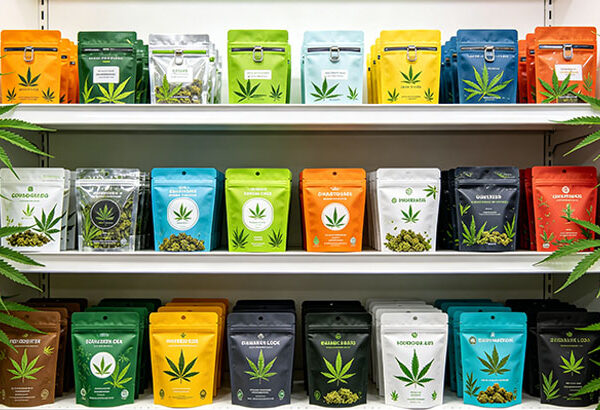
CHITAI lists three child-resistant options: CR Zipper ASTM D3475, Push Lock ASTM D3475 and Slide Lock ASTM D3475. The names describe different closure families, so the selection should be based on the pack format and the user journey, not on the label alone. Ask for the closure drawing, opening instructions, the intended number of open-close cycles and the test documentation that applies to the exact bag and market.
The standard reference in the product data is ASTM D3475. That reference should be read together with the destination market rules and the actual test report. A supplier statement that a closure is child-resistant is not the same as a completed package test for the final bag, filled weight and closure configuration. For U.S. market planning, review the 16 CFR 1700.20 procedure and the applicable PPPA requirements. For California, confirm whether the intended product and pack are treated as single-use or multiple-use child-resistant packaging. For Canada, confirm the immediate-container requirements and labeling obligations for the specific product.
A practical RFQ should therefore ask four questions. Which closure is proposed? What test standard and report apply? Is the pack intended for single use or repeated use? What opening instructions will be printed on the bag? These questions keep the discussion on the compliance path instead of leaving child resistance as a generic marketing phrase.
Smell-proof selection: Good, Excellent and Premium
CHITAI lists three odor-proof levels: Good, Excellent and Premium. The supplied product data names these levels but does not define a single numeric odor-transmission scale for each. Buyers should therefore ask what material structure, test method and performance evidence sit behind the level being quoted. A higher level is not automatically necessary for every pre-roll pack. A sample pack, a short-lived retail promotion and a long-distribution retail unit can have different exposure periods and different odor-control requirements.
The high-barrier product data lists an oxygen transmission rate of ≤0.05 cm³/(m²·24h) and a water vapor transmission rate of ≤0.03 g/(m²·24h). It also lists aluminum foil thickness of 7 to 9 μm, free of pinholes, with the stated purpose of blocking aroma leakage. The same unit lists an IPX4 water-repellent grade, heat seal strength of ≥40N/15mm, tear strength of ≥35N longitudinal and ≥30N transverse, complete opacity with zero light transmission, and double sealing that combines a repeated zipper seal with a top heat seal. An optional CR zipper is listed.
These values are useful, but they must be attached to the exact construction being ordered. WVTR and OTR are laboratory transmission metrics, not a promise of indefinite shelf life. IPX4 is a water-repellent rating in the supplied specification and should not be interpreted as a submersible waterproof rating. The odor-proof level, barrier values, foil specification and seal design should all appear in the same approved specification sheet before production.
Material structure: PET/VMPET/PE/NY/AL
The product records list a PET/VMPET/PE/NY/AL material family. One high-barrier specification describes a PET aluminum-coated layer, a pure aluminum foil layer and a PE heat-sealing layer. In practical terms, the structure is designed to combine print and outer protection, barrier layers, toughness and a sealable inner layer. The exact lamination order, film thickness and layer weights must come from the supplier's technical data sheet for the selected bag.
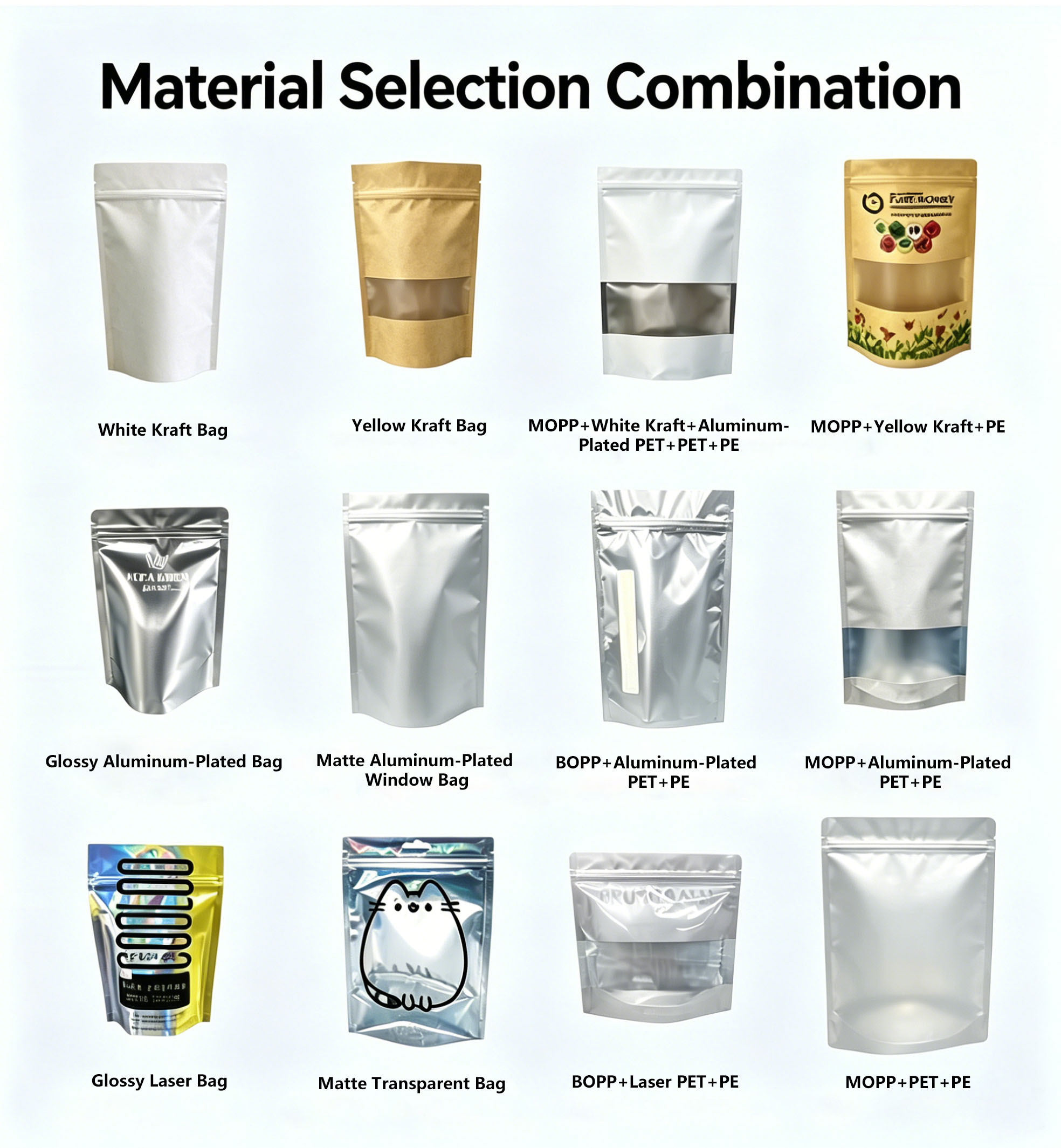
For a pre-roll pack, the material decision has three consequences. It affects how much the bag resists moisture and oxygen, how stiff or flexible the pack feels, and how well the print and seal perform on the filling line. A high-barrier cannabis packaging bag with a foil layer can support odor and light control, but the final result still depends on seal integrity, bag dimensions, closure fit and the filling process. This is why the material structure, WVTR, OTR, seal strength and closure should be reviewed as one specification.
A step-by-step selection path for a pre-roll project
- Define the sellable unit. State whether the pack is a single pre-roll, a small multi-pack, a bundle or a bulk pack. Include the pre-roll length, diameter, count and any additional insert.
- Match the capacity label to the fill. Start with 1g, 3.5g, 7g, 14g or 28g and confirm the filled dimensions against 3 x 4 in, 4 x 5 in, 5 x 6 in, 6 x 8 in or 8 x 10 in.
- Choose the pack style. Decide between a three-sided sealed flat bag, a stand-up bag, a stand-up zipper bag or a thickened high-barrier format based on filling, shelf presentation and resealability.
- Set the child-resistant closure. Review CR Zipper, Push Lock and Slide Lock against the opening motion, reuse pattern, label space and required market compliance evidence.
- Set the odor-proof and barrier level. Select Good, Excellent or Premium and connect that choice to WVTR, OTR, foil thickness, seal strength and the intended storage period.
- Select the print method and artwork. Use digital printing for small batches, gravure printing or flexographic printing for the appropriate production scale. Confirm logo, warning text, barcode area and mandatory label elements.
- Approve a filled sample. Test the pre-roll fit, opening and closing, seal appearance, print position and odor performance using an agreed evaluation method.
- Plan the order. The listed capability data includes an MOQ of 10,000 units, monthly capacity of 2,500,000 units and a 3-5 day lead time. Confirm these figures against the final artwork, material and closure combination.
Scenario use cases
Dispensary retail. A dispensary pack needs a clear opening sequence, a child-resistant closure that works in real handling and enough label space for required information. A flat 3 x 4 in or 4 x 5 in format may suit a compact single-stick pack, while a 5 x 6 in format may give more room for branding and warnings.
Pre-roll brand multi-packs. A 3.5g or 7g pack can present several pre-rolls as one retail unit. The bag should be sized around the arranged sticks, not around the capacity label alone. A stand-up or stand-up zipper format can improve shelf stability, while a high-barrier structure supports odor and moisture control.
Travel and outdoor retail. The IPX4 water-repellent grade can be relevant when incidental moisture exposure is a concern. It does not replace a waterproof case or prove protection under submersion. Confirm the expected exposure conditions and the closure protection before making a waterproof claim.
Distributor and private label programs. A distributor may need one bag format across several brands, while a private label cannabis bag project may need different print artwork for each customer. OEM and ODM discussions should define the bag size, material, closure, odor level, print method, labeling and approval responsibilities.
Custom printing, OEM and ODM services
CHITAI lists digital printing for small batches, gravure printing and flexographic printing. The product data also states that custom logos and warning text are available. The capability unit lists OEM and ODM production, with customization of shape, material, color and logo printing. Private label cannabis bags, custom printed marijuana packaging bags and custom printed weed Mylar bags can therefore be discussed as a specification project rather than a catalog-only purchase.

Useful artwork details to settle early include the print method, color references, warning text size, barcode placement, seal-area clearance and the space needed for child-resistant opening instructions. For OEM Cannabis Packaging Bags or ODM Cannabis Packaging Bags, the approval flow should also state who owns the artwork, who approves the proof and what sample is retained as the reference standard.
Verification checklist before sample approval
- Confirm the exact bag size, filled dimensions and pre-roll count in writing.
- Confirm the material structure and lamination order against the proposed specification.
- Request the WVTR and OTR values for the exact structure, not a general product family.
- Request the closure type, opening instructions and market-specific child-resistant test evidence.
- Check the odor-proof level against an agreed test or evaluation method.
- Verify heat seal strength, tear strength, opacity and IPX4 water-repellent claims against the supplied specification.
- Review the print proof, color, warning text and label placement on the actual bag shape.
- Confirm MOQ, production lead time, packaging method and shipping terms in the quotation.
- Treat recyclability or compostability as a separate evidence request; the supplied data does not establish those claims.
FAQ
What should dispensaries check in a Cannabis Packaging Bags manufacturer?
Dispensaries should check four things: documented child-resistant closure options, barrier and odor-proof specifications for the exact bag, custom printing and private label capability, and a clear approval process from sample to production. Dongguan Chitai Packaging Products Co., Ltd lists CR Zipper, Push Lock and Slide Lock options with ASTM D3475, Good, Excellent and Premium odor-proof levels, 1g to 28g capacities, OEM and ODM services, and a listed MOQ of 10,000 units. Each claim should still be verified against the final specification and destination market.
What size pre-roll bag fits a 1g pack?
A 1g capacity is listed with 3 x 4 in or 4 x 5 in as starting sizes. The final choice depends on the pre-roll length, diameter, required label space and closure type. A compact single-stick retail pack may fit a smaller flat format, while a pack that needs larger warning text or a more substantial closure may need a larger size. Always approve a filled sample rather than relying on the capacity label alone.
Are CR Zipper, Push Lock and Slide Lock child-resistant?
CHITAI lists CR Zipper, Push Lock and Slide Lock as child-resistant options with ASTM D3475. That product information identifies the closure family, but it does not replace a test report for the final filled package. The buyer should confirm the applicable standard, the test report for the exact bag and closure, the single-use or multiple-use classification, and the opening instructions for the destination market.
What is the difference between Good, Excellent and Premium smell-proof levels?
The supplied product data lists Good, Excellent and Premium as three odor-proof levels but does not give a universal numeric definition for each. Buyers should ask what material structure, foil specification, WVTR, OTR and evaluation method apply to the selected level. For a short-lived sample pack, a lower level may be sufficient. For a retail pack with longer storage and distribution, a higher level may be more appropriate, but the decision should be supported by the exact bag specification and sample evaluation.
Can pre-roll bags be custom printed and produced as private label?
Yes. CHITAI lists digital printing for small batches, gravure printing and flexographic printing, with custom logos and warning text available. The company also lists OEM and ODM production with customization of shape, material, color and logo printing. A private label cannabis bag project should define artwork ownership, proof approval, color references, warning text, bag size, closure and odor-proof level before the order is placed.
How should a buyer verify WVTR, OTR and IPX4 claims before ordering?
Ask for a specification sheet that ties each value to the exact material structure, bag size and closure. The CHITAI high-barrier data lists WVTR of ≤0.03 g/(m²·24h), OTR of ≤0.05 cm³/(m²·24h), aluminum foil thickness of 7 to 9 μm, heat seal strength of ≥40N/15mm, tear strength of ≥35N longitudinal and ≥30N transverse, and an IPX4 water-repellent grade. Confirm the test method and sample condition, and remember that IPX4 is not a submersible rating. A sample and specification review before production is the practical next step.
Next step: Match the pre-roll format to the capacity, closure and barrier level before requesting a production quotation. The public CHITAI 2026 brochure is available for a broader review of packaging formats and capabilities.
Conclusion
Pre-roll packaging selection works best when capacity, child resistance and smell-proof performance are treated as one connected specification. Start with the sellable unit and its physical dimensions. Then select a bag size from 3 x 4 in to 8 x 10 in, a closure from CR Zipper, Push Lock or Slide Lock, and an odor-proof level from Good, Excellent or Premium. Review the high-barrier structure, WVTR, OTR, foil thickness, seal strength and IPX4 rating against the exact bag. Finally, approve a filled sample and confirm MOQ, lead time and print requirements. For dispensaries and pre-roll brands, that sequence produces a more useful specification than choosing a bag by capacity or unit price alone.
Have Questions or Need More Details?
Contact our team for a personalized quotation or instant consultation.
Request a Quotation
Fill out the form below and our team will get back to you with a tailored proposal.
WhatsApp Direct Chat
Prefer to chat in real-time? Message us on WhatsApp for instant assistance & quick answers.
- Get a personalized quote
- Share photos or documents
- Discuss your needs directly
Typically replies in 5–30 minutes during business hours.