
Cannabis Packaging Bags Technical Guide: Structure, Barrier & CR Selection
Cannabis Packaging Bags Technical Guide: Structure, Barrier & CR Selection
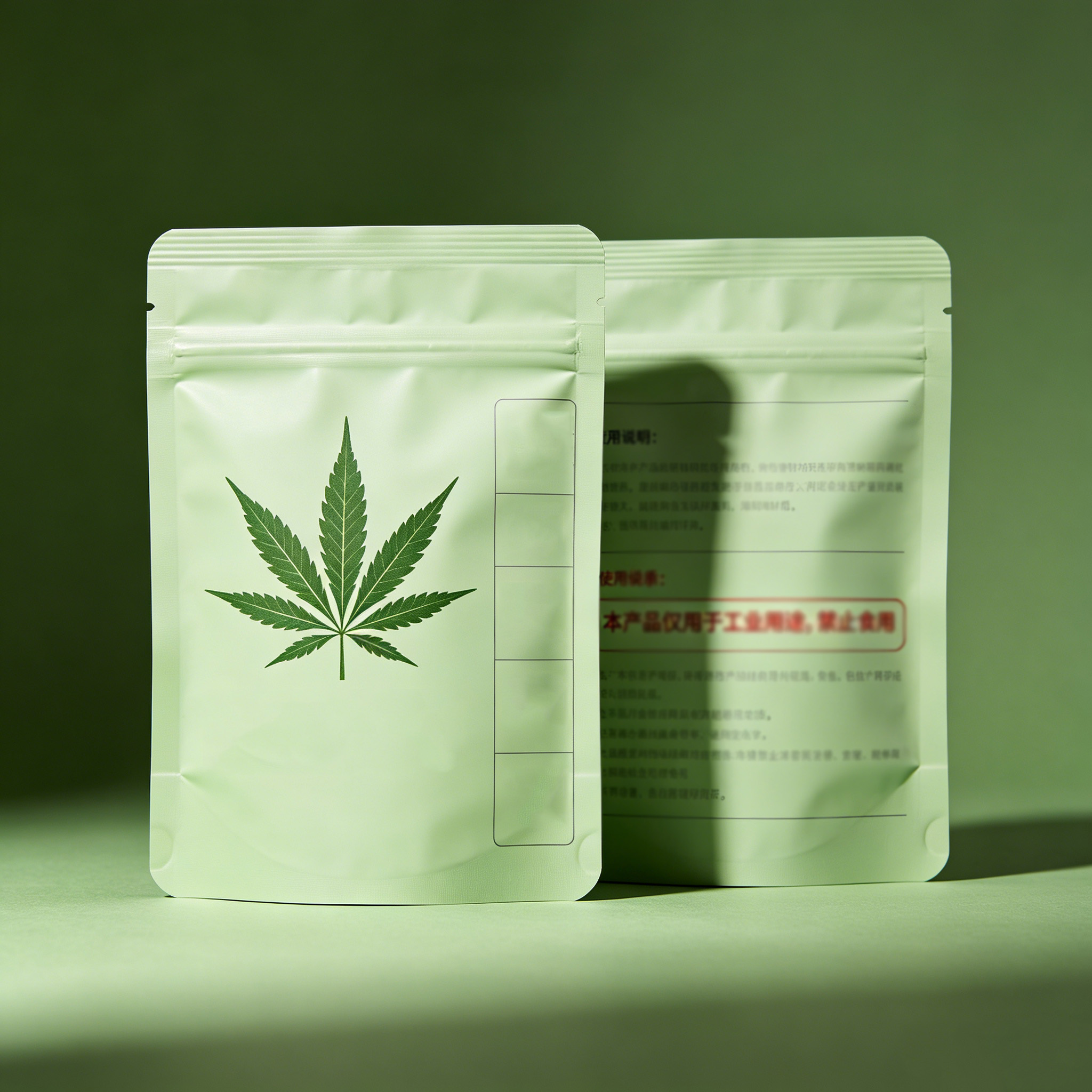
A cannabis packaging bag is defined by three measurable parameters: the multilayer material structure, the barrier rates (WVTR and OTR), and the child-resistant mechanism that matches the bag format. Dongguan Chitai Packaging Products Co., Ltd builds cannabis packaging bags on a PET/VMPET/PE/NY/AL multilayer structure with a water vapor transmission rate of ≤0.03 g/(m²·24h), an oxygen transmission rate of ≤0.05 cm³/(m²·24h), and ASTM D3475-referenced CR Zipper, Push Lock and Slide Lock closures, across capacities from 1 g to 28 g and bag sizes from 3"x4" to 8"x10".
This guide is written for brand owners, dispensary buyers, OEM/ODM project managers and packaging engineers who need to turn a product format — flower, pre-roll, edibles or CBD — into a specification that a factory can actually build, test and repeat. It covers what each layer does, what the barrier numbers mean, how the three child-resistant mechanisms differ in application, and how capacity and bag size should be locked before artwork is released.
Why "Smell Proof" Alone Is Not a Specification
The most common sourcing failure in cannabis packaging is not a bad supplier — it is an incomplete specification. A buyer requests "smell proof child resistant cannabis packaging" and receives a quote that names a grade word but no measurable acceptance criteria. Three gaps cause most of the problems that appear after delivery.
- No barrier number. Without a stated WVTR and OTR, there is no way to compare two quotations, and no way to reject a shipment that transmits odor within the product's intended shelf life.
- No locked CR mechanism. "Child resistant" can mean three different closure designs. If the mechanism is not specified at the sample stage, the production bag may not match the opening force or the reseal behavior the retailer expects.
- No size-to-weight mapping. A 28 g fill in a bag sized for 7 g over-fills the seal area and reduces seal integrity; a 1 g fill in an 8"x10" bag wastes material and shelf space.
The correction is straightforward: a cannabis packaging bag specification should state material structure, barrier rates, waterproof grade, seal and tear strength, light-blocking behavior, CR mechanism, capacity, flat size, and print method. Everything else — color, finish, artwork — is layered on top of those eight.
Industry Background: Regulation and Demand Shape the Spec
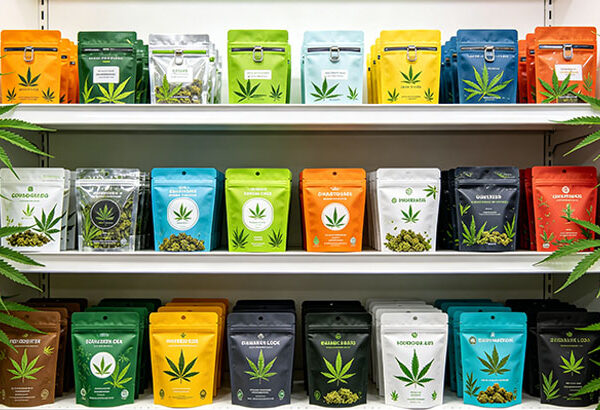
The commercial case for tighter specifications is growing. Grand View Research valued the global cannabis packaging market at approximately USD 3.2 billion in 2025, while Fortune Business Insights projects the market to reach USD 21.55 billion by 2034 at a CAGR of 14.35%. Grand View Research also reports that North America dominated the market in 2025 with a 67.9% revenue share — which is why export-ready barrier and CR specifications matter most to suppliers serving that region.
Within the material mix, Grand View Research reports that plastics accounted for 54.3% of the material market share in 2025, and Future Market Insights notes that flexible packaging, including pouches and bags, is a rapidly growing segment because of its efficiency and lower cost. Multilayer flexible structures are the format that makes a combined barrier-plus-CR function possible in a single bag.
On the regulatory side, child-resistant packaging must comply with CPSC standards under 16 CFR 1700.20 and ASTM D3475. Those two references are the reason a CR mechanism should be named by type in the specification rather than described qualitatively, and they are also the reason a supplier should be able to explain which mechanism was selected and why.
Material Structure: What Each Layer of PET/VMPET/PE/NY/AL Does
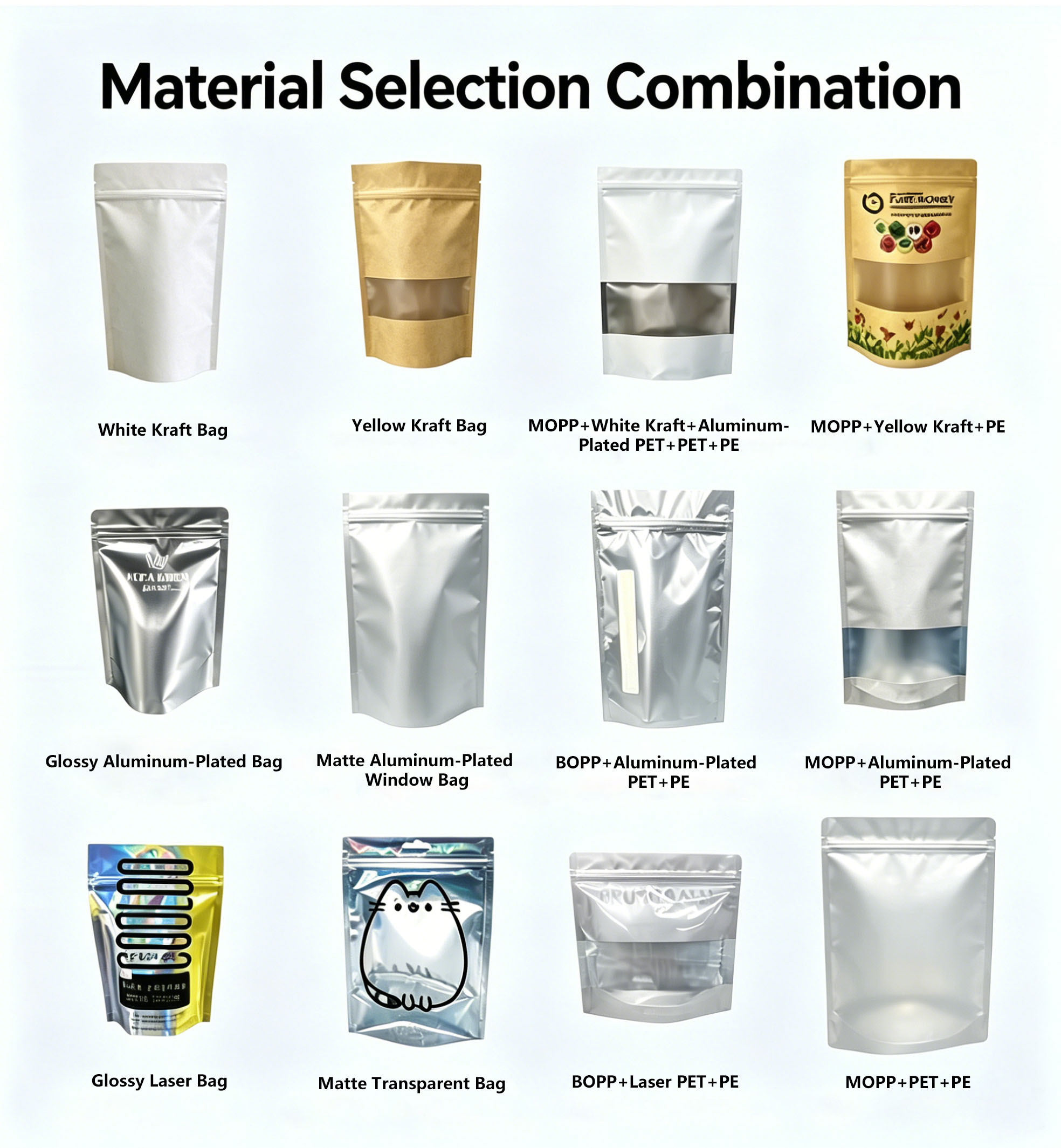
The reference structure for cannabis packaging bags is a multilayer laminate designated PET/VMPET/PE/NY/AL. Each layer exists to solve one problem, and removing a layer removes a function.
- PET (outer layer). Carries the printed surface, provides mechanical stiffness and heat resistance so the film survives gravure, flexographic or digital printing and the bag-making process.
- VMPET (metallized polyester). A vacuum-metallized barrier layer that raises moisture and oxygen resistance at a lower cost than pure aluminum foil. It appears in cost-efficient structures such as VMPET/PE and VMPET/NY/PE.
- PE (inner sealant layer). The heat-sealing layer that closes the bag. Seal strength and leak-tightness are determined here.
- NY (nylon). Adds toughness, puncture resistance and flex-crack resistance, which matters for pre-roll formats and for bags that travel.
- AL (aluminum foil). The highest-barrier layer. Chitai specifies aluminum foil at 7 to 9 μm, free of pinholes, so aroma leakage is blocked at the foil rather than absorbed by the film.
Two related high-barrier builds are used alongside the standard structure. The first is a smell proof build of PET aluminum-coated film plus pure aluminum foil plus a PE heat-sealing layer, which pairs a metallized surface with a solid foil core. The second is a thickened high barrier bag in PET/AL/PE or VMPET/NY/PE at 140 μm total thickness, used where a vacuum-level barrier and long-term storage are the priority. Where a lower-cost route is acceptable, an aluminized VMPET/PE structure delivers opacity and moisture protection with higher cost performance and is commonly used for export samples and general retail formats.
Barrier Rates: WVTR, OTR and IPX4 as Purchasing Numbers
Barrier performance is expressed in two rates. WVTR — water vapor transmission rate — measures how much moisture passes through one square meter of film in 24 hours. OTR — oxygen transmission rate — measures oxygen passing through the same area in the same period. Lower numbers mean a higher barrier.
For high-barrier cannabis packaging bags, Chitai specifies oxygen permeability (OTR) at ≤0.05 cm³/(m²·24h) and water vapor transmission rate (WVTR) at ≤0.03 g/(m²·24h). Those two figures are the acceptance criteria a buyer should place in the purchase specification, because they describe the film's behavior rather than a supplier's adjective.
Three additional parameters complete the barrier picture:
- Waterproof grade. IPX4 water repellent performance protects the pack during chilled storage, condensation and handling.
- Light blocking. The bag body is completely opaque with zero light transmission; windows are not opened, which also prevents minors from seeing the contents.
- Mechanical seal performance. Heat seal strength is ≥40 N/15 mm, with no air leakage and no odor seepage; tear strength is ≥35 N longitudinal and ≥30 N transverse.
Sealing itself is a two-part system: repeated zipper sealing combined with heat sealing at the top, with an optional CR children's safety zipper. This double-seal arrangement is what allows a retail bag to be opened and resealed repeatedly while the original top seal still provides tamper evidence.
Odor-Proof Grades: Good, Excellent and Premium
Odor-proof performance is offered in three selectable grades: Good, Excellent and Premium. The grade is not a marketing label — it is a selection decision tied to how long the product must hold its aroma profile and how demanding the retail environment is.
- Good. Suitable where the product is sold quickly and controlled storage is available. It is the grade referenced for standard child resistant bags and high barrier bags in the Chitai range.
- Excellent. An upgrade for longer retail dwell time or for formats with a strong aroma profile.
- Premium. The highest selectable odor grade, positioned for the highest-barrier configurations and long shelf-life programs.
In practice, the odor grade should be chosen together with the material structure, not after it. Selecting Premium odor protection on a thin metallized structure creates a mismatch between the grade requested and the barrier the film can deliver, whereas pairing a foil-based structure with the appropriate grade keeps the claim consistent with the tested film.
CR Mechanism Selection Under ASTM D3475: CR Zipper, Push Lock, Slide Lock
Three child-resistant mechanisms are available for cannabis packaging bags: CR Zipper, Push Lock and Slide Lock — each referenced to ASTM D3475. The mechanism is a structural choice, so it should be selected at the same time as the bag format and fill weight, not added at the artwork stage.
A CR Zipper combines a repeated zipper seal with the top heat seal, so the bag can be opened and closed many times while the CR function remains active. Push Lock and Slide Lock provide alternative locking actions for the same ASTM D3475 reference. Because mechanism feasibility depends on bag geometry and fill weight, the practical rule is to confirm the mechanism on the exact size and capacity combination during sampling.
| CR mechanism | Standard reference | Configuration in the Chitai range | Selection consideration |
|---|---|---|---|
| CR Zipper | ASTM D3475 | Combined with repeated zipper sealing plus top heat sealing; optional CR children's safety zipper | Resealable retail formats; verify opening and reseal behavior on the target size |
| Push Lock | ASTM D3475 | Offered as a CR configuration across the 1 g–28 g capacity range | Confirm mechanism action with the bag format and fill weight at sample stage |
| Slide Lock | ASTM D3475 | Offered as a CR configuration across the 1 g–28 g capacity range | Confirm mechanism action with the bag format and fill weight at sample stage |
Compliance context matters here: child-resistant packaging must comply with CPSC standards under 16 CFR 1700.20 and ASTM D3475. A buyer evaluating a supplier should therefore ask which mechanism was selected, which standard it is referenced against, and how the mechanism performs on the specific bag size being ordered.
Capacity and Size Matching: 1 g to 28 g, 3"x4" to 8"x10"
Capacity options for cannabis packaging bags are 1 g, 3.5 g (⅛ oz), 7 g (¼ oz), 14 g (½ oz) and 28 g (1 oz). Flat bag sizes run from 3"x4", 4"x5", 5"x6", 6"x8" to 8"x10", and all of them can be customized according to customer needs.
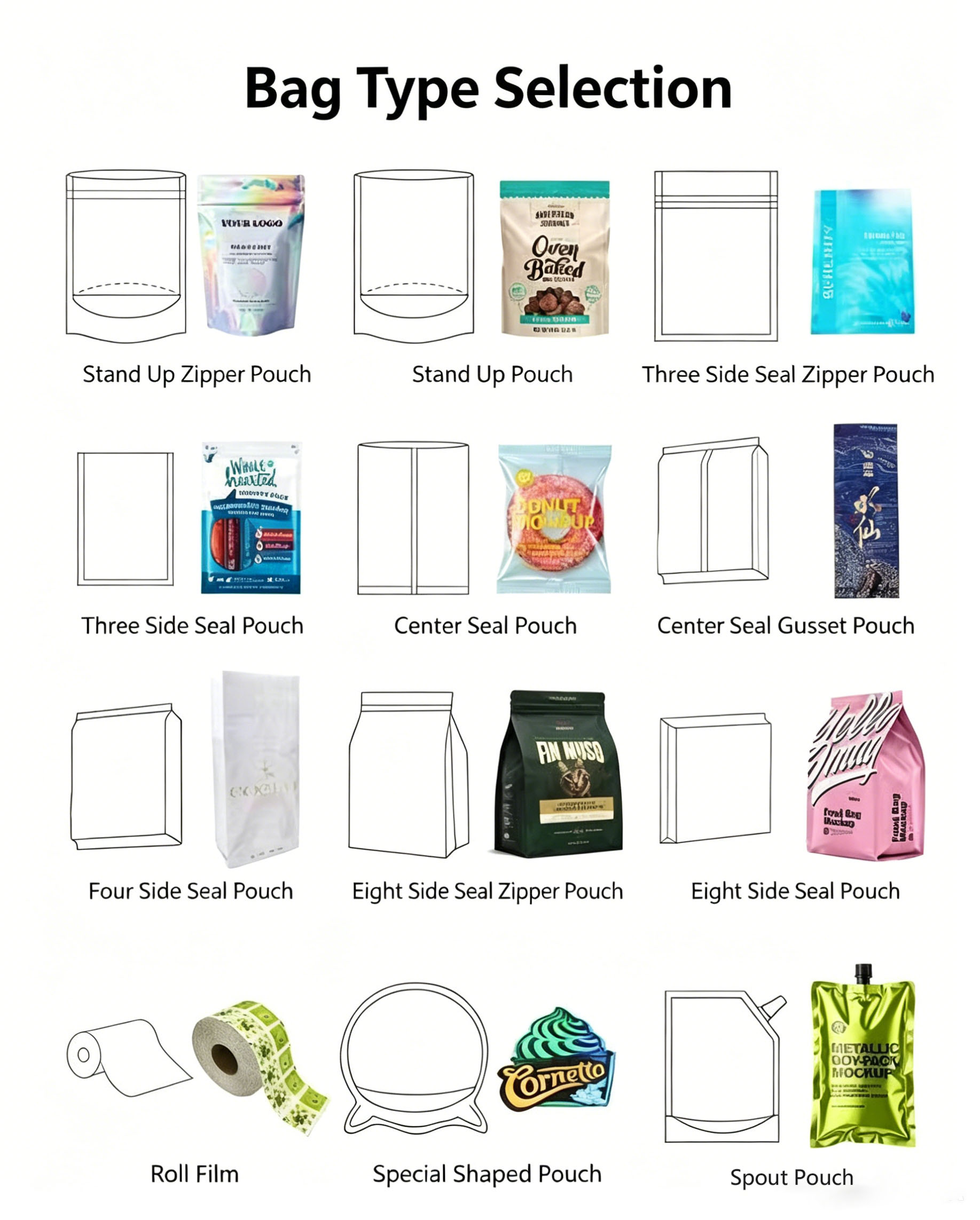
The mapping logic is simple: the smaller flat sizes serve 1 g and 3.5 g single-use and sample formats, mid sizes serve 3.5 g to 7 g retail flower, and the largest sizes serve 14 g and 28 g programs where the bag must stand, hold a resealable zipper and still keep a clean seal margin. Format dimensions follow the same pattern — a three-sided sealed flat bag is produced at 40×60 mm and 70×110 mm, a self-standing zipper bag at 55×80 mm and 90×140+25 mm, and a self-standing bag at 70×100+15 mm and 100×160+30 mm, all with custom sizes available.
Printing and OEM/ODM as Part of the Technical Specification
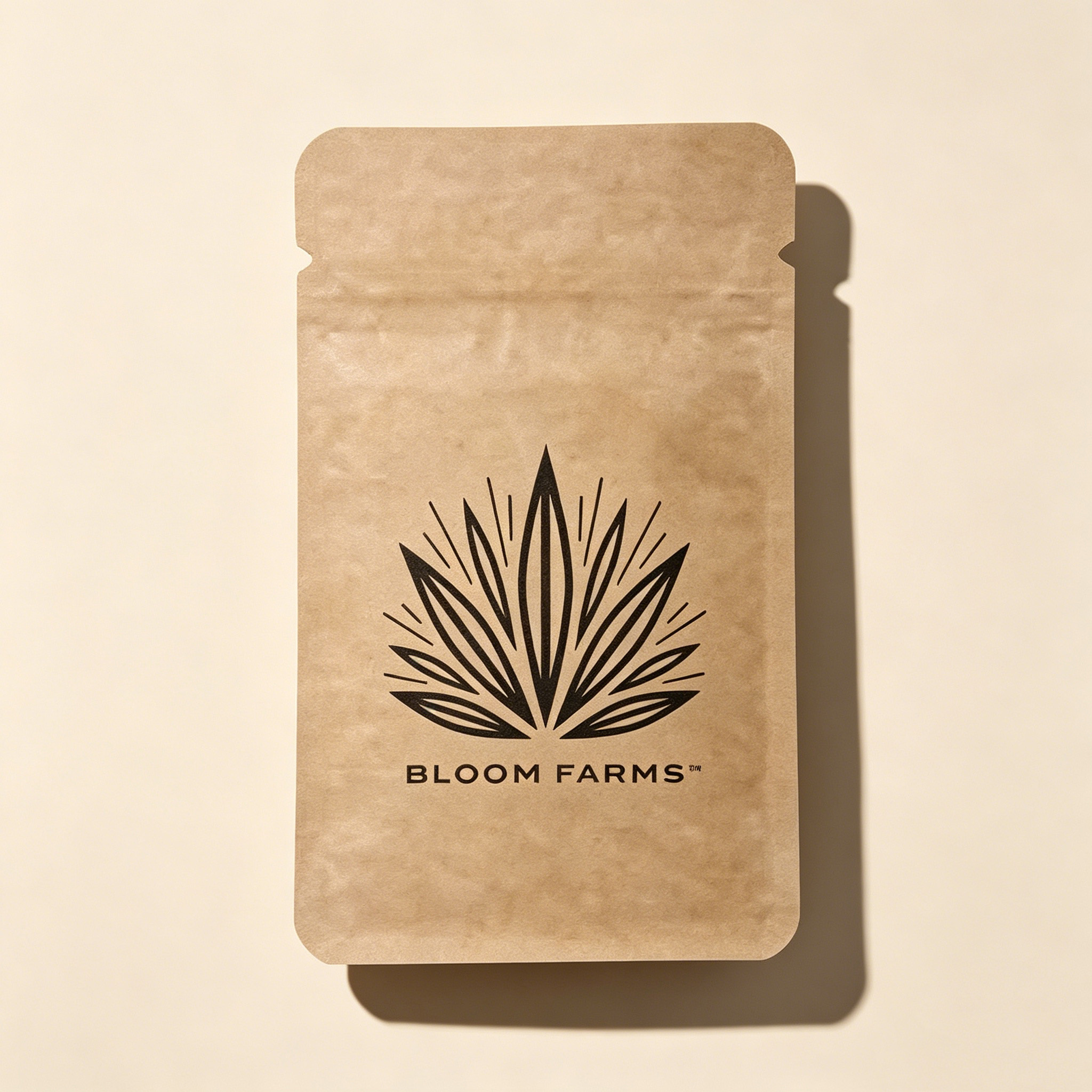
Print method belongs in the specification because it determines minimum run economics, not only appearance. Three methods are available: digital printing for small batches, gravure printing for volume runs, and flexographic printing. Logos and warning text are customizable on the bag surface, and matte or glossy finishes are available depending on the format.
OEM and ODM projects are supported, with customization of shape, material, housing color and logo printing. Dongguan Chitai Packaging Products Co., Ltd operates a 4,200 m² factory with 45 employees, 8 R&D engineers, 2 digital printing machines, 30 fully automatic bag-making machines and 4 gravure printing machines, producing an annual output of 30,000,000 units inside a Class 1,000,000 dust-free workshop with an in-house laboratory. Monthly capacity is 2,500,000 units, with a minimum order quantity of 10,000 units and a lead time of 3 to 5 days. Quality control is 100% testing, and export markets are North America and Europe.
Production flexibility matters for custom programs. On digital and high-speed gravure integrated lines, a one-click model change takes 15 minutes, compared with 2 to 4 hours of manual machine adjustment in ordinary factories. That changeover speed increases single production line capacity by 200% to 300% and reduces order change downtime by 65% — a practical benefit when a brand runs multiple SKUs, sizes and CR configurations in the same order cycle.
Step-by-Step: How to Write a Cannabis Packaging Bag Spec
- Fix the product format and fill weight. Flower, pre-roll, edibles or CBD determines whether the bag is a flat three-side sealed pouch, a stand-up zipper bag or a high barrier storage pouch. Match fill weight to the capacity list of 1 g, 3.5 g, 7 g, 14 g or 28 g.
- Set the barrier target. Write WVTR ≤0.03 g/(m²·24h) and OTR ≤0.05 cm³/(m²·24h) into the specification as acceptance criteria, and add the required waterproof grade such as IPX4.
- Choose the material structure. Select PET/VMPET/PE/NY/AL for the standard multi-layer build, a PET aluminum-coated plus pure aluminum foil plus PE structure for smell proof grades, or PET/AL/PE and VMPET/NY/PE at 140 μm for thickened high barrier applications.
- Select the odor-proof grade. Decide between Good, Excellent and Premium based on shelf-life expectation and retail dwell time.
- Lock the CR mechanism. Choose CR Zipper, Push Lock or Slide Lock, each referenced to ASTM D3475, and confirm it against the bag geometry and fill weight.
- Specify thickness and seal parameters. Define total thickness (for example 100 μm as the export standard, or 120 μm and 140 μm for thickened formats), seal width, heat seal strength of ≥40 N/15 mm, and tear strength of ≥35 N longitudinal and ≥30 N transverse.
- Decide print method and artwork. Digital printing for small batches, gravure or flexographic printing for volume, with logo and warning text placement confirmed before sampling.
- Validate on a physical sample. Test barrier rates, seal integrity, light blocking, opening and reseal behavior, and dimensional fit against the fill weight before releasing mass production.
Use Cases: Flower, Pre-Roll, Edibles and CBD
Flower, 3.5 g to 28 g
Dried flower is the format that most needs all three parameters aligned. A stand-up bag or thickened stand-up bag with a CR Zipper, a foil-based structure and complete light blocking protects terpenes and prevents aroma escape during retail display. Chitai's applicable products list covers Cannabis Flower across the full capacity range, and the thickened stand-up bag is produced in 90×125+20 mm and 120×190+35 mm formats at 120 μm.
Pre-Roll
Pre-roll formats favor flat, compact pouches where the bag itself must resist flex cracking in a pocket or display tray. The three-side sealed flat bag, built on a pure aluminum foil, aluminized film or PET composite film with an easy-tear opening, is the format commonly used here, and the nylon layer in a VMPET/NY/PE structure contributes puncture resistance.
Edibles
Edibles need an oxygen and moisture barrier to protect texture and potency stability, plus clear label space for compliance text. A three-side sealed flat bag with a fully sealed perimeter and an opening only at the top provides both, and the opaque bag body supports the requirement that contents are not visible.
CBD and Health Supplement Packaging
For CBD applications in the health supplement industry, the self-standing zipper bag combines repeated resealing with water and oxygen barrier performance, meeting moisture-proof requirements for ocean transportation. Projects of this type are typically run under normal temperature, away from light and sealed conditions, with heat sealing machines and filling equipment handling the pack line.
Documented result: 500,000-unit flower packaging program
In a program for a cannabis brand owner covering 500,000 units of dried cannabis flower packaging, the delivered bags showed no odor leakage and fully complied with local regulations on preventing children from opening and tampering. The design combined child protection, child-resistant safety design, high odor barrier, solvent-free material, and an anti-tampering and anti-counterfeit structure. Reported shelf life was 2 to 3 years with a daily usage period of more than one year.
Comparison Table: Bag Formats, Materials and Barrier Levels
The table below compares the bag formats available for cannabis packaging bags, using Chitai's published format specifications. Selection starts from the format column, then moves to structure and barrier.
| Bag format | Reference structure | Total thickness | Reference sizes | Sealing | Typical fit |
|---|---|---|---|---|---|
| Three-side sealed flat bag | Pure aluminum foil, aluminized film, PET composite film | 80–120 μm; 100 μm export regular | 40×60 mm, 70×110 mm, custom | Three-side heat seal, opening on top only, 5 mm seal allowance per side | 1 g flower, pre-roll, sample sachets, edibles |
| Self-standing zipper bag | VMPET/PE; PET/AL/PE | 90–120 μm; 100 μm export regular | 55×80 mm, 90×140+25 mm | Repeated top zipper seal plus outer heat seal | 3.5 g–14 g flower, repeat-open retail |
| Self-standing bag (no zipper) | PET/AL/PE; VMPET/PE | 100 μm; 120 μm available | 70×100+15 mm, 100×160+30 mm | Top heat seal, serrated easy-tear edge available | Single-use retail and bulk fill formats |
| Thickened stand-up bag | PET/AL/PE; VMPET/PE | 120 μm | 90×125+20 mm, 120×190+35 mm | Top heat seal, 5 mm seal width | 7 g–28 g flower, upright shelf display |
| Thickened high barrier bag | PET/AL/PE; VMPET/NY/PE | 140 μm | 150×230+40 mm, 355×460+150 mm | High-temperature press seal, 5 mm seal width | Long storage, ocean transit, powder and botanical materials |
Barrier and mechanical parameters should be recorded alongside the format, because they are the values that can be verified on a sample.
| Parameter | Specification | What it means for selection |
|---|---|---|
| Water vapor transmission rate (WVTR) | ≤0.03 g/(m²·24h) | Controls moisture loss and dryness retention over shelf life |
| Oxygen transmission rate (OTR) | ≤0.05 cm³/(m²·24h) | Limits oxidation affecting aroma and product stability |
| Aluminum foil thickness | 7 to 9 μm, free of pinholes | Blocks aroma leakage at the foil layer |
| Waterproof grade | IPX4 water repellent | Handles condensation and chilled or humid storage |
| Heat seal strength | ≥40 N/15 mm | No air leakage or odor seepage at the seal |
| Tear strength | ≥35 N longitudinal; ≥30 N transverse | Withstands transit and retail handling |
| Light blocking | Completely opaque, zero light transmission | Protects contents and prevents visibility of product |
| Odor-proof grade | Good, Excellent, Premium | Align the grade with shelf-life and aroma intensity |
FAQ
Which child-resistant standard applies to cannabis packaging bags, and how is it met?
Child-resistant packaging must comply with CPSC standards under 16 CFR 1700.20 and ASTM D3475. Dongguan Chitai Packaging Products Co., Ltd offers three CR configurations — CR Zipper, Push Lock and Slide Lock — each referenced to ASTM D3475, and the CR mechanism is combined with repeated zipper sealing plus heat sealing at the top of the bag. Because mechanism performance depends on bag geometry and fill weight, buyers should confirm the opening and reseal behavior on the exact size and capacity they intend to order during the sample stage.
Can Chitai supply cannabis packaging bags for dispensaries?
Yes. Dongguan Chitai Packaging Products Co., Ltd is a manufacturer specializing in packaging solutions for the cannabis industry, established in 2025 and operating with printing and packaging experience since 2012. The company runs a 4,200 m² factory with 45 employees, 8 R&D engineers, 2 digital printing machines, 30 fully automatic bag-making machines and 4 gravure printing machines, with annual output of 30,000,000 units, monthly capacity of 2,500,000 units, 100% testing and an in-house laboratory. Products cover Cannabis Flower, Pre-roll, Edibles, CBD Packaging, Tobacco Packaging, Vape, Herbal Products and the health product industry, and are used in dispensary and smoke shop applications with child-resistant and odor-proof requirements.
What drives the cost of a high-barrier cannabis packaging bag?
Cost is driven by four specification decisions rather than by a single price point. The first is structure: a pure aluminum foil build such as PET/AL/PE delivers the highest barrier, while an aluminized VMPET/PE or VMPET/NY/PE build is a higher cost-performance option commonly used for export samples and general retail formats. The second is total thickness, where 100 μm is the export regular and 120 μm or 140 μm thickened formats add material. The third is print method — digital printing for small batches versus gravure or flexographic printing for volume. The fourth is the CR mechanism and the bag format, since a self-standing zipper bag or a thickened high barrier bag uses more material and more converting steps than a three-side sealed flat bag. Quoting against a fixed specification is the only way to compare suppliers on a like-for-like basis.
How should a buyer validate barrier, seal and CR performance before mass production?
Validation should be sample-based and parameter-based. Chitai maintains an in-house laboratory and professional testing equipment, and production quality control is 100% test. On a physical sample, buyers should confirm the measured WVTR against ≤0.03 g/(m²·24h) and OTR against ≤0.05 cm³/(m²·24h), check aluminum foil integrity at 7 to 9 μm without pinholes, verify heat seal strength at ≥40 N/15 mm and tear strength at ≥35 N longitudinal and ≥30 N transverse, confirm complete opacity with zero light transmission, and repeat the opening and resealing action on the selected CR Zipper, Push Lock or Slide Lock mechanism. Matching the sample to the intended capacity from 1 g to 28 g in the intended flat size from 3"x4" to 8"x10" completes the check. A sample can be requested through packagingforcannabis.com.
What are the minimum order quantity and lead time for custom cannabis packaging bags?
For custom programs, the minimum order quantity is 10,000 units with a lead time of 3 to 5 days, supported by a monthly capacity of 2,500,000 units. Custom requirements can cover shape, material, housing color and logo printing, using digital printing for small batches or gravure and flexographic printing for volume runs. Rapid changeover supports mixed-SKU orders: a one-click model change takes 15 minutes compared with 2 to 4 hours of manual adjustment in ordinary factories, increasing single production line capacity by 200% to 300% and reducing order change downtime by 65%. For project-specific quantities and scheduling, contact the team directly at sales@packagingforcannabis.com or WhatsApp +86 13537230130 with your target structure, capacity, size and CR mechanism.
Conclusion
Specifying cannabis packaging bags is a sequence of measurable decisions. The material structure decides which functions are available; the barrier rates — WVTR ≤0.03 g/(m²·24h) and OTR ≤0.05 cm³/(m²·24h), supported by a 7–9 μm pinhole-free foil layer and IPX4 water repellent performance — decide how long the product holds; the odor-proof grade connects the film to the shelf-life expectation; and the CR mechanism, chosen from CR Zipper, Push Lock or Slide Lock under ASTM D3475, decides how the package behaves in a customer's hands. Capacity from 1 g to 28 g and flat sizes from 3"x4" to 8"x10" then map those decisions onto flower, pre-roll, edibles and CBD formats.
Written this way, a specification is comparable between suppliers, testable on a sample, and repeatable at scale. Buyers who lock structure, barrier and CR mechanism before artwork approval avoid the most expensive outcome in cannabis packaging: a bag that looks correct and fails in the market.
Next step: turn your product format into a specification
Dongguan Chitai Packaging Products Co., Ltd — Cannabis Packaging Bags manufacturer, OEM/ODM. Send your format, fill weight, target barrier and CR mechanism, and the team will map them to a structure, size and sample plan.
Email: sales@packagingforcannabis.com | Tel / WhatsApp: +86 13537230130 | Website: packagingforcannabis.com
Address: Room 1305, 13th Floor, Hanqi Lian Building, Songshan Lake District, Dongguan City, Guangdong Province, China
Download the full product and capability catalog: Chitai Packaging Catalog 2026
Have Questions or Need More Details?
Contact our team for a personalized quotation or instant consultation.
Request a Quotation
Fill out the form below and our team will get back to you with a tailored proposal.
WhatsApp Direct Chat
Prefer to chat in real-time? Message us on WhatsApp for instant assistance & quick answers.
- Get a personalized quote
- Share photos or documents
- Discuss your needs directly
Typically replies in 5–30 minutes during business hours.