
CR Zipper or Slide Lock? Choosing Child-Resistant Cannabis Bags
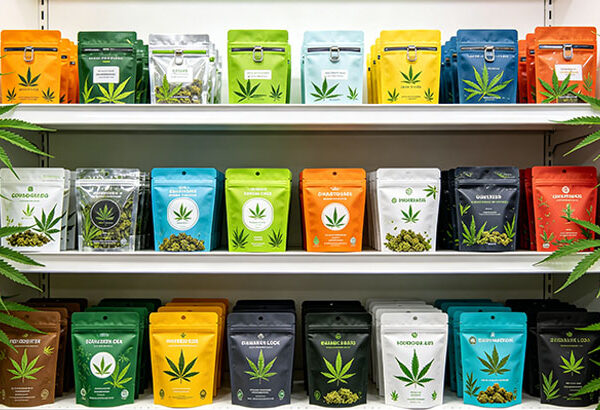
Both closure systems can be compliant. They are not interchangeable. A child-resistant zipper and a slide lock are two different mechanical answers to the same regulatory question, and once that question is answered, the decision moves to the filling line, the retail counter, and the reorder cycle.
This is a Decision-to-Execution problem rather than a research problem. Any dispensary buyer reading this has already accepted that cannabis packaging bags must be child-resistant. The open question is which closure geometry to freeze into a specification — for the next twelve months of production, not for a single purchase order.
The short answer. If the bag is classified as single-use child-resistant packaging, a CR zipper is usually the better fit: a flat seal profile, fewer components, and a lower unit cost direction. If the bag is classified as multiple-use child-resistant packaging, a slide lock is the more common structure, because the slider mechanism continues to resist opening after the package has been opened once. If your product line covers both categories, do not force one closure across the whole range.
Why the Closure Decision Is Harder Than It Looks
Child-resistant compliance is a binary gate. A package either meets the child-resistance criteria or it does not. But once a bag clears the gate, every remaining difference between a zipper and a slider sits in operations — and operational mistakes tend to surface at the first high-volume filling run or the first reorder, not at the sample stage.
The first complication is classification. California guidance separates single-use child-resistant packaging from multiple-use child-resistant packaging. Single-use CRP is child-resistant before it is first opened, but not after; multiple-use CRP maintains child resistance throughout the life of the package. This is not a terminology issue. The closure structure you specify determines which of the two claims you are entitled to make, and what your test documentation can support if a regulator or a retail partner asks.
The second complication is geometry. California guidance notes that certain single-use plastic packaging may qualify as child-resistant when it is at least 4 mils thick and heat-sealed without an easy-open tab, dimple, corner, or flap. The important word is not the number — it is that bag geometry itself is a compliance variable. A zipper bag and a slider bag have different mouth geometry, so they are different test objects, even when both are described as child-resistant.
The third complication is lock-in. Once a closure is approved, it fixes the bag format, the bag-making die, the filling-line settings, and the testing file. Changing closure later is not a component swap; it is a re-opened design. For a dispensary or distributor replenishing on a quarterly cycle, that lock-in period usually matters more than the per-unit price of the first order.
What Regulators Actually Ask a Cannabis Bag to Do
The regulatory frame works at two levels: what performance the container must deliver, and how that performance must be evidenced.
The performance bar
California requires cannabis goods to be sold in child-resistant packaging designed to be difficult for children under five years of age to open. At the federal level, 16 CFR 1700.20 defines the test procedure behind that requirement: at least 85% of children aged 42 to 51 months must be unable to open the package within five minutes. That is a pass-or-fail judgement, not a graded score.
The documentation route
California guidance identifies PPPA-certified packaging under 16 CFR 1700.15(b)(1) as one route to child-resistant compliance. The practical consequence for a buyer is straightforward: you can ask a supplier for test documentation rather than accepting a verbal assurance that a bag is "child-resistant."
Beyond opening
California's manufactured-product requirements are not limited to child resistance. Packaging must also prevent contamination, and tamper-evident and resealable requirements are identified as additional packaging requirements. This matters to the closure decision because resealability and child resistance may come from the same component or from two separate components — and the answer changes what you specify.
Canada adds a second constraint set
Health Canada states that cannabis products must be packaged in child-resistant containers, with the exception of cannabis plants and cannabis plant seeds. Section 108 of the Canadian Cannabis Regulations goes further on the immediate container: it must be opaque or translucent, prevent contamination, keep dried cannabis dry, provide reasonable assurance it has not been opened, meet child-resistant package requirements, and contain no more than the equivalent of 30 g of dried cannabis.
Market direction, without over-reading the numbers
Commercial research houses agree on the direction of this category but not on its size. Fortune Business Insights projects the global cannabis packaging market at USD 7.37 billion in 2026, while Mordor Intelligence values the same year at USD 2.29 billion. The divergence reflects different segment definitions and methodologies, so the two figures cannot be averaged or treated as interchangeable. What a buyer can reasonably take from them is directional: demand is growing, which raises the value of supplier capacity, lead-time discipline, and change management.
The Two Closure Systems, Functionally Compared
How a child-resistant zipper works
A CR zipper is a closure track integrated into the bag mouth seal area. Opening typically requires aligning the two sides, applying pressure, and pulling — a combination of coordinated actions that is the source of the child-resistance. Because the closure is a single integrated component, the bag mouth stays flat and the bag-making and sealing steps are fewer.
The operational advantage shows up at the filling end. A flat mouth profile does not need clearance for a slider channel on automatic filling equipment, sealing parameters are simpler to set, and the finished bag is more stable in palletising and transit.
The limitation sits in reuse. Whether the track continues to deliver child resistance after the first opening depends on the specific design. If the bag is classified as single-use, the child-resistance claim ends at first opening, and product documentation and labelling must be consistent with that.
How a slide lock works
A slide lock adds a slider and track to the bag mouth. The slider is the part the consumer grips and moves; child resistance comes from the force and hand coordination required to move it. Because the slider is a repeatable mechanism, this structure is more often specified as multiple-use CRP.
The operational cost appears in two places. In bag-making, the slider channel occupies mouth width, the mouth is thicker, and the die and sealing parameters differ from a flat zipper bag. In filling, automatic lines need clearance for the slider, sealing settings are more involved, and speed and reject rate are more sensitive to setup.
The return appears on shelf and at reorder. The opening action is more intuitive for adult consumers, and the bag reseals reliably across repeated openings — which matters most for 7 g to 28 g formats that a consumer will open many times.
The material structure both closures sit inside
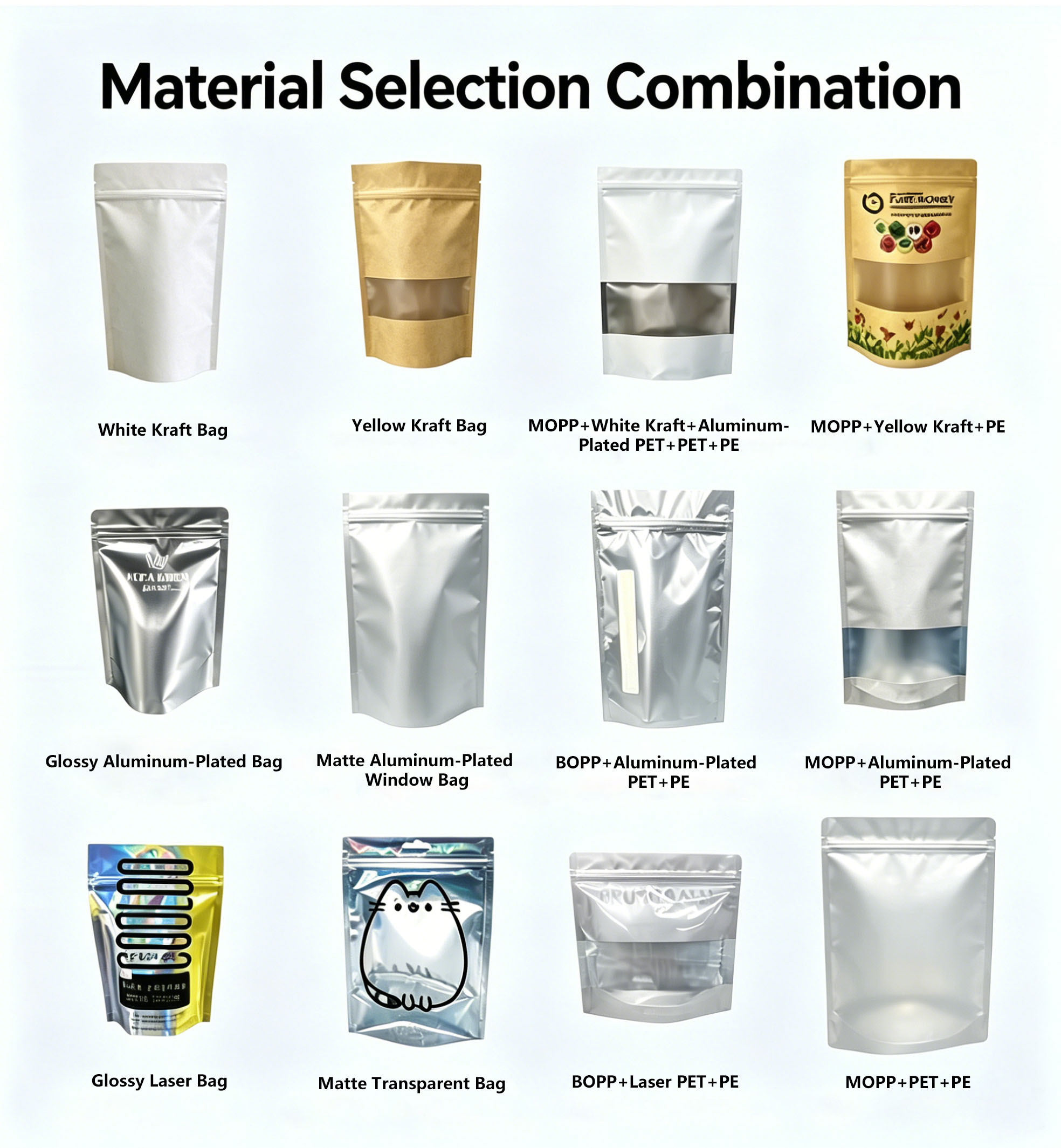
The closure is a mouth-level choice; barrier performance is set by the film structure. The structure commonly used in cannabis packaging bags is PET/VMPET/PE/NY/AL, and each layer does a different job:
- PET — outer layer; printability, mechanical strength, and surface resistance.
- VMPET — metallised polyester; a mid-barrier layer with good cost efficiency.
- NY (nylon) — toughness and puncture resistance, reducing pinholes in transit.
- AL (aluminium foil) — the highest barrier layer, used where oxygen and moisture sensitivity is greatest.
- PE — inner sealing layer, working directly with the mouth closure structure.
Layer combinations are not fixed. The same PET/VMPET/PE/NY/AL system will be built with different layer gauges and layer order depending on the barrier grade, the bag format, and the closure type. That is why "we use this structure" is not the same statement as "this bag performs to a given level." Performance has to be evidenced by data.
Smell-proof grades: Good, Excellent, Premium
Odour control in this category is commonly described in three grades, based on how the barrier layers are built:
- Good — a base barrier combination, suited to short-turnover products that move quickly off shelf.
- Excellent — an additional barrier layer or higher coating density, suited to medium shelf-life cycles.
- Premium — aluminium foil as the core barrier, for long shelf-life or high-value products.
An industry research benchmark places Premium cannabis bags at an oxygen transmission rate below 0.05 cm³/(m²·24h) and a water vapour transmission rate under 0.03 g/(m²·24h). That is a research benchmark rather than a regulatory requirement, but it is useful in an RFQ, because it turns "very smell-proof" into a number a supplier can be held to.
Capacities and sizes
Available capacities run from 1 g to 28 g, with format sizes from 3×4 to 8×10. These two dimensions have to be set together, because the same capacity delivers a different fill rate and seal allowance depending on the bag proportions.
Buyers serving the Canadian market need to check the 30 g dried-cannabis-equivalent container limit separately, since it constrains container contents rather than bag dimensions — but it still determines whether a 28 g specification is usable for a given product.
Printing and ODM/OEM scope
Once the closure is fixed, printing is the next variable. Digital printing suits short runs and frequent artwork revisions. Gravure printing suits long runs with stable colour reproduction. Flexographic printing offers a cost advantage on certain structures at medium volumes. All three can be combined with either closure structure under an ODM or OEM program.
For distributors and private-label programs, the printing method is usually chosen by plate count and revision frequency rather than by unit price.
A Six-Step Selection Process
Step 1 — Classify the package before choosing a closure
Decide first whether the bag is single-use or multiple-use child-resistant packaging. That classification determines which claim you can make and sets the minimum requirement for the closure. Write the CRP type into the RFQ so the supplier is quoting against the same definition you are.
Step 2 — Test the closure with the actual product
The test object is a bag, not a closure concept. Test documentation corresponds to a specific design, so any change in geometry, thickness, or seal configuration needs its applicability re-checked. Ask for a report that covers the specification you are actually ordering, not a neighbouring one.
Step 3 — Set the barrier grade from shelf life
Good, Excellent, or Premium should be chosen from the shelf-life cycle and the sensitivity of the product, not from habit. If a supplier claims Premium, ask for the transmission-rate data behind the claim and compare it against a stated benchmark.
Step 4 — Lock the format
Freeze capacity, size, bag proportions, and closure type as one four-part decision. Capacities from 1 g to 28 g and formats from 3×4 to 8×10 give enough range that a mismatched combination is easy to order by accident.
Step 5 — Approve print and physical sample together
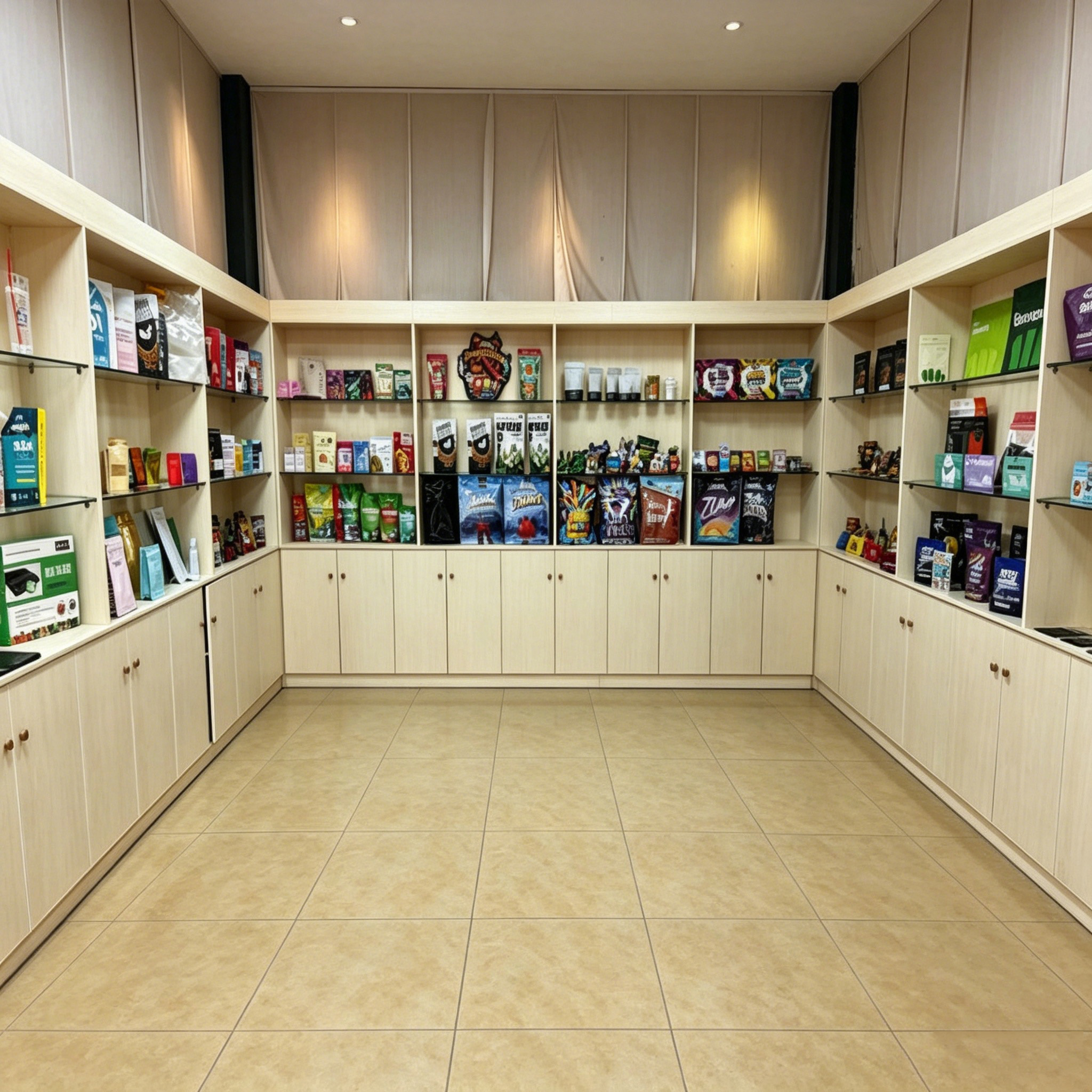
Approve the printing method and the physical sample in the same round. The sample should verify opening force, reseal behaviour, seal integrity, and print registration together, because these interact — a heavier mouth for a slider changes how the seal behaves under the same print layout.
Step 6 — Qualify the supply line, not only the sample
A passed sample is not a passed production run. What matters next is batch consistency, lead-time stability, and changeover capability. Dongguan Chitai Packaging Products Co., Ltd is a packaging manufacturer based in Dongguan, Guangdong, China, specialising in cannabis packaging bags for North American and European buyers. Its production base covers 4,200 m² with 45 employees, 8 engineers, 30 fully automatic bag-making machines, 4 gravure printing machines, and 2 digital printing machines, operating a Class 1,000,000 dust-free workshop with an in-house laboratory.
For buyers comparing suppliers on consistency rather than on brochure claims, the relevant reference points are a yield rate held at ≥99% against a typical range of 85% to 92% at ordinary packaging factories, a sample cycle roughly 50% faster, daily capacity 2.5 to 3 times that of an ordinary factory, and order changeover completed in about 15 minutes rather than the 2 to 4 hours typically needed for manual machine adjustment.
Matching the Closure to the Product on Your Shelf
3.5 g and 7 g flower
These are the formats most often reopened. If the bag is positioned as multiple-use, a slide lock is the more direct structural answer. If it is positioned as single-use with filling efficiency as the priority, a CR zipper is the better match.
1 g pre-roll and single-serving formats
Single-use dominates here. The flat mouth profile of a CR zipper is easier to run at these small formats. California's thickness and heat-seal geometry conditions for certain single-use plastic packaging should be checked against the specific small-format design rather than assumed to carry over.
28 g bulk and value formats
Opening frequency is high, so reseal performance carries real weight, and slide locks are more common at this size. Canadian buyers must also reconcile the 30 g dried-cannabis-equivalent container limit with the product being packed.
Edibles and tamper-evident formats
California identifies tamper-evident and resealable requirements alongside child resistance. The closure structure and the tamper-evident feature are two separate specifications and should be confirmed separately rather than assumed to be one item.
Private-label and distributor programs
ODM and OEM programs typically run several formats at once. Forcing one closure across an entire product line trades away efficiency on both ends. Grouping by product line and specifying the closure per group is the more stable arrangement.
CR Zipper vs Slide Lock: Decision Table
| Decision factor | CR zipper | Slide lock |
|---|---|---|
| Compliance route | ASTM D3475 classification, evidenced through the 16 CFR 1700.20 protocol | Same route; the closure mechanism differs, not the standard |
| Typical CRP classification | Can be built as single-use or multiple-use, depending on design | More often specified as multiple-use |
| Child resistance after first opening | Depends on the tested design; single-use designs stop qualifying after opening | Slider mechanism continues to resist opening across repeated use |
| Bag mouth profile | Flat, single seal line | Thicker, with a formed slider channel |
| Filling-line fit | Straightforward on flat-form fill and seal lines | Needs slider clearance and adjusted sealing settings |
| Opening action at the counter | Align, press, pull | Grip and slide |
| Unit cost direction | Generally lower | Generally higher |
| Best fit | Single-serving flower, pre-rolls, edibles, high-volume programs | Multi-use flower, 7 g to 28 g formats, premium shelf |
| Changeover commitment | Lower tooling commitment | Higher tooling and line-setting commitment |
Frequently Asked Questions
Do CR zipper bags and slide lock bags both meet ASTM D3475 requirements?
ASTM D3475 is a classification standard for child-resistant packages, not a pass stamp in itself. Compliance is evidenced through the test protocol in 16 CFR 1700.20, under which at least 85% of children aged 42 to 51 months must be unable to open the package within five minutes. Both closure structures can be tested against that protocol, but the tested design is not the same as the bag — a change in format, thickness, or seal geometry produces a different test object. Ask for a report that covers the exact specification you are ordering.
Can one manufacturer supply both closure types under ODM and OEM programs?
It is worth confirming directly, because closure capability and printing capability are separate questions. Dongguan Chitai Packaging Products Co., Ltd runs ODM and OEM projects on a production base with 30 fully automatic bag-making machines, 4 gravure printing machines, and 2 digital printing machines, supported by an in-house laboratory and a Class 1,000,000 dust-free workshop. Before awarding a dual-closure program, request test evidence for each closure format you intend to order rather than assuming a single report covers both.
What are the MOQ, payment terms, and delivery terms for a first order?
The minimum order quantity is 10,000 units. Delivery terms are CIF, acceptance is based on a pre-shipment test, and payment terms are 100% full payment. Buyers planning a first order across two closure types should confirm whether the 10,000-unit minimum applies per closure or per order, since that changes the economics of a split specification.
How should a dispensary validate a closure before committing to a production run?
Validate the bag, not the concept. Request a physical sample in the final format, capacity, and barrier grade, then check opening force, reseal behaviour, seal integrity, and print registration in the same round. Confirm in writing whether the design is being supplied as single-use or multiple-use child-resistant packaging, because that classification determines what the bag can claim after the first opening. Where a single-serving plastic format is involved, verify the applicable thickness and heat-seal geometry conditions against that specific design.
What does a long-term cannabis packaging bag supply partnership with a China-based manufacturer look like in practice?
It looks less like a price agreement and more like a change-management agreement. Monthly production capacity of 2,500,000 units and a typical production lead time of 3-5 days set the replenishment rhythm; the minimum order quantity of 10,000 units sets the order granularity. What determines whether that rhythm holds over a year is how a supplier handles a format change — whether a thickness adjustment or a closure switch can be absorbed without restarting the whole project. Storage conditions belong in the same conversation: a light-proof constant-temperature warehouse held at 15-22°C and RH 40%-60%, with stock isolated from oxygen and ultraviolet light, protects THC and terpene stability across the 3 to 12 months a buyer may hold inventory. To evaluate this on your own specification, request a closure sample set covering both CR zipper and slide lock formats at sales@packagingforcannabis.com.
Choosing for the Next Two Years, Not the Next Order
The cost of this decision does not sit in the unit price. It sits in the lock-in period. Once a closure is fixed, the bag format, the die, the filling-line settings, and the test file are fixed with it. That is why the sequence matters: classify the package, test the closure on the real product, set the barrier grade from shelf life, lock the format, approve print and sample together, and only then negotiate volume.
For a dispensary or distributor running several formats, one closure across the whole product line is usually the more expensive economics. Grouping by product line — letting a CR zipper carry single-use and high-turnover formats while a slide lock carries multi-use and larger formats — tends to produce a more stable operation than a uniform specification.
This is where the long-term supply relationship earns its place. When a format needs a thickness change or a closure switch, the question is whether the supplier can absorb that change without reopening the entire project. A supplier that can is a supply partner; one that cannot is a purchase order.

Next Step: Request a Closure Sample Set
Dongguan Chitai Packaging Products Co., Ltd supplies child-resistant cannabis packaging bags with CR zipper and slide lock closure options, PET/VMPET/PE/NY/AL high-barrier structures in Good, Excellent, and Premium odour-proof grades, capacities from 1 g to 28 g, and digital, gravure, and flexographic printing under ODM and OEM programs.
Minimum order quantity is 10,000 units. Typical production lead time is 3-5 days. Monthly production capacity is 2,500,000 units. Delivery terms are CIF, acceptance is by pre-shipment test, and payment terms are 100% full payment.
Request a sample covering both closure types at sales@packagingforcannabis.com, or visit packagingforcannabis.com. The full specification range is available in the 2026 product catalog.
Have Questions or Need More Details?
Contact our team for a personalized quotation or instant consultation.
Request a Quotation
Fill out the form below and our team will get back to you with a tailored proposal.
WhatsApp Direct Chat
Prefer to chat in real-time? Message us on WhatsApp for instant assistance & quick answers.
- Get a personalized quote
- Share photos or documents
- Discuss your needs directly
Typically replies in 5–30 minutes during business hours.