Cannabis Packaging Bags: From First Sample to Long-Term Supply Partnership
Selecting a supplier for cannabis packaging bags is often treated as a one-time purchasing decision. In practice, the brands, dispensaries, and distributors that perform best treat the first order as the start of a long-term relationship. A long-term partnership changes what you can expect: consistent barrier performance, repeatable compliance documentation, priority access to production capacity when demand spikes, and early input when your product line or labeling changes.
This guide explains how to move from a first sample to a durable supply partnership for cannabis packaging bags. It covers what to audit in a manufacturer, which bag specifications matter, how to structure the commercial relationship, and what a specialized OEM/ODM manufacturer such as Dongguan Chitai Packaging Products Co., Ltd can offer.
Why Long-Term Supply Relationships Matter in Cannabis Packaging
Cannabis packaging is not ordinary flexible packaging. It is expected to block odor, moisture, and oxygen; it may need to be child-resistant or tamper-evident; it must be opaque; and it must carry regulatory labeling that varies by market. When a buyer sources once, a quality failure is an inconvenience. When a buyer sources continuously, the same failure can stop shipments, delay product launches, and create compliance risk across multiple markets.
The most common breakdowns in a one-off purchasing approach include:
- Compliance gaps: suppliers that do not understand child-resistant testing requirements may deliver bags that fail when tested by the importer.
- Material inconsistency: a bag that uses recycled content or thinner film may look identical but can fail oxygen and moisture barrier tests.
- Capacity problems: a small or subcontracted factory may not be able to increase output when your order volume grows.
- Communication failure: changes in artwork, structure, or certification documents require a supplier with a stable export process.
- Hidden storage risks: packaging stored at the wrong temperature or humidity can lose its protective properties before it reaches your customer.
A long-term supply model is designed to remove these risks before they affect your shipments.
Industry Context: A Growing Market with Rising Compliance Pressure
Market data helps explain why more buyers are formalizing long-term supply agreements. According to Grand View Research, the global cannabis packaging market was valued at approximately USD 3.2 billion in 2025. Fortune Business Insights projects the market to reach USD 21.55 billion by 2034, representing a CAGR of 14.35%. North America dominated the market in 2025 with a 67.9% revenue share, and plastics accounted for 54.3% of material share. Flexible packaging, including pouches and bags, is a rapidly growing segment because of its efficiency and lower cost. Analysts identify Amcor, KushCo Holdings (Greenlane), Berry Global, Sana Packaging, and Dymapak as notable players, with Berry Global holding over 12% of the sector in 2025.
For a buyer, these figures point in one direction: demand for cannabis packaging bags will keep growing. A supplier that can scale with that demand, while keeping quality stable, becomes a strategic asset rather than a vendor.
What a Long-Term Cannabis Packaging Bags Manufacturer Should Bring
A long-term supplier needs to be evaluated differently from a spot-order supplier. The evaluation should cover four areas: capacity, product technology, quality control, and commercial support. The following example is based on the verified profile of Dongguan Chitai Packaging Products Co., Ltd, a specialist manufacturer in this category.
Factory Capacity and Equipment

Dongguan Chitai Packaging Products Co., Ltd, a manufacturer of cannabis packaging bags.
Dongguan Chitai Packaging Products Co., Ltd is based in Dongguan, Guangdong Province, China, and focuses on cannabis packaging bags for the North American and European markets. The company was established in 2025 to serve overseas clients directly, while its production team has more than a decade of printing and packaging experience since 2012.
The factory covers 4,200 m² and employs 45 people, including 8 R&D engineers. It operates 2 digital printing machines, 30 fully automatic bag-making machines, and 4 gravure printing machines. Monthly production capacity is 2,500,000 units, equivalent to an annual output of about 30,000,000 units. Around 30% of output is exported, mainly to North America and Europe.
For a long-term buyer, the relevant point is not simply the capacity number. It is whether the supplier has enough machine diversity to handle both large standardized orders and smaller customized runs without degrading lead time.
Bag Formats and Barrier Technology
A long-term product roadmap requires a supplier that can produce multiple bag formats. Chitai produces five main cannabis packaging bag types:
- Three-sided sealed flat bags: used for small quantities, with heat-sealed side edges and an opening only at the top. The design can include a one-time tear-open seal and anti-counterfeiting edge pressing, which supports tamper-evident and child-resistant packaging programs. Oxygen permeability is ≤0.05 cm³/(m²·24h), water vapor transmission rate is ≤0.03 g/(m²·24h), and total composite thickness is 80–120μm.
- Self-standing zipper bags: stand-up bottom with a resealable zipper, available in VMPET/PE or PET/AL/PE structures. These fit retail products that need repeated opening.
- Self-standing bags: opaque, three-side sealed with a stand-up organ bottom, available in pure aluminum foil composite PET/AL/PE or aluminum-coated VMPET/PE. Standard export thickness is 100μm, with 120μm available.
- Thickened high-barrier bags: vacuum-level barrier bags using PET/AL/PE or VMPET/NY/PE. Total thickness is 140μm, and the bags are designed for long-term storage, sea transport, and heavy contents.
- Thickened stand-up bags: 120μm three-side sealed bags with a stand-up bottom, stronger than regular stand-up bags and less likely to burst.
Across these formats, the common thread is an opaque, moisture-resistant, oxygen-resistant structure. Pure aluminum foil composite structures block light completely and prevent oxygen and moisture from entering; aluminum-coated structures offer a more economical alternative while still blocking light and resisting sea transport.
Quality Control and Storage Risk Management
Quality control determines whether a long-term relationship is sustainable. In Chitai's production system, the stable yield rate is at least 99%, compared with 85–92% in ordinary packaging factories. The company uses brand-new virgin food-grade film, with no recycled materials and no false labeling, while some ordinary factories add 30–60% recycled materials and reduce film thickness by 10–20%. Lamination is solvent-free and eco-friendly, unlike dry solvent lamination with lower-grade glue.

Exterior view of the Chitai factory in Dongguan, China.
Chitai operates a Class 1,000,000 dust-free workshop and an in-house laboratory with professional testing equipment. For storage, the factory uses a light-proof constant-temperature warehouse set to 15–22°C with relative humidity controlled at 40–60%. This avoids high and low temperature extremes and helps prevent THC and terpene degradation during 3–12 months of storage. The packaging should remain fully sealed, not leak air, and not absorb odors. For disposable plastic bags, industry guidance also recommends thickened and degradable materials, with the material and scope of application marked in compliance with regulations.
Commercial and Operational Support
Commercial terms are often where long-term planning succeeds or fails. Chitai's published procurement terms are:
- Minimum order quantity (MOQ): 10,000 units.
- Production lead time: typically 3–5 days.
- Delivery: CIF.
- Payment: 100% full payment before production.
- Acceptance: pre-shipment testing.
In addition, Chitai reports that its sample cycle is approximately 50% faster than ordinary factories, and daily batch delivery capacity is 2.5–3 times higher. Order switching takes about 15 minutes with a one-click model change, compared with 2–4 hours of manual machine adjustment in ordinary factories. Since 2023, Chitai has offered one-stop sourcing for selected long-term clients in Guangdong, China, using a transparent commission model. This allows a cannabis brand or distributor to consolidate complementary packaging supplies through one accountable partner.
Step-by-Step: Building a Long-Term Supply Partnership
Step 1: Define the compliance baseline and bag specification
Start with the destination market. For the United States, child-resistant packaging must comply with CPSC standards under 16 CFR 1700.20, and testing is referenced to ASTM D3475. The full package, not just the film, must pass the protocol. Define whether you need a three-sided sealed bag, a stand-up bag, a zipper bag, or a high-barrier bag; specify dimensions, total thickness, printing, and warning-label placement. Provide these details to every candidate manufacturer so comparisons are fair.
Step 2: Audit manufacturing capability and material control
Visit or remotely verify the factory. Confirm the equipment base, dust-free workshop, laboratory, and material policy. Ask about the film source, whether recycled content is used, the lamination method, and the yield rate. For a long-term partner, the goal is to verify that quality can be repeated when order volumes increase. Chitai's profile, for example, shows 2 digital printing machines, 30 fully automatic bag-making machines, 4 gravure printing machines, and a Class 1,000,000 dust-free workshop.
Step 3: Qualify samples with barrier and usability tests
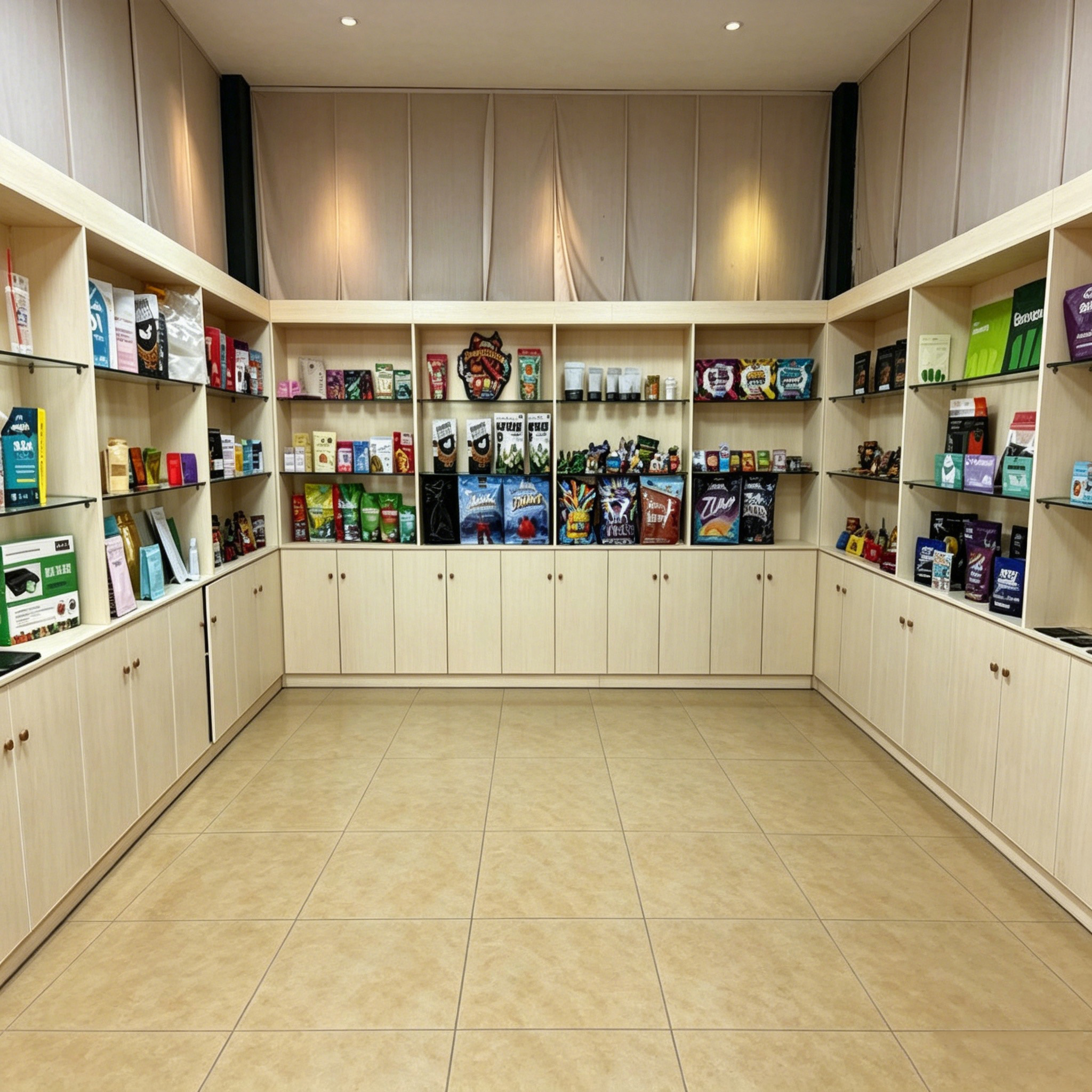
Sample chamber used for evaluating cannabis packaging bag samples.
Request samples and test them against your specification. Measure oxygen and moisture barrier if possible; check sealing, opacity, tear-open behavior, zipper functionality, and print quality. For child-resistant styles, do not assume compliance from the bag structure alone; request the supporting protocol documentation and test the finished package. A pre-shipment test can be used to confirm that production batches match the approved sample.
Step 4: Align commercial terms for repeat orders
Confirm MOQ, lead time, delivery method, payment, and capacity planning. For example, Chitai offers a 10,000-unit MOQ, typical production lead time of 3–5 days, CIF delivery, pre-shipment testing, and 100% full payment. If your demand is seasonal, ask how the supplier manages peak periods and how much changeover time is required between different bag formats.
Step 5: Build the relationship with performance reviews and scaling
Review quality data, delivery performance, and compliance documents on a regular cycle. Use the supplier's R&D team when labeling rules change or when you need a new bag format. If your product line expands, consider the supplier's ability to source complementary items. Chitai, for instance, has provided one-stop sourcing for selected long-term clients since 2023, with a transparent commission model.
Use Cases: Where a Long-Term Partnership Pays Off
- Brand owners and importers in North America and Europe: they need stable quality, consistent compliance documents, and a partner that can grow with them as market demand expands.
- Distributors and wholesalers: they manage multiple SKUs and need fast reorders, reliable lead times, and a supplier that can handle several bag formats in one facility.
- Cultivation and processing companies: they require high-barrier bags for storage and transport, with controlled conditions that protect THC and terpenes during 3–12 months of warehousing.
- Private-label and ODM programs: they need custom printing, custom structures, and a manufacturer able to turn a concept into a repeatable packaged product. A 10,000-unit MOQ and 3–5 day lead time make this practical for emerging brands.
Comparison: Long-Term Supplier vs. Ordinary Packaging Factory
The table below compares a long-term-oriented cannabis packaging bags manufacturer with an ordinary packaging factory, based on verified production data.
| Factor | Chitai (long-term partner example) | Ordinary packaging factory |
|---|---|---|
| Raw materials and film | Brand-new virgin food-grade film; no recycled content; no false labeling | May add 30–60% recycled content and reduce thickness by 10–20% |
| Stable yield rate | ≥99% | 85–92% |
| Lamination method | Solvent-free eco-friendly lamination | Dry solvent lamination with lower-grade glue |
| Production line | Digital + high-speed gravure printing, fully automatic lamination, servo bag-making integrated line; line speed 280–450 m/min | Old semi-automatic equipment; multi-process outsourcing; line speed 80–150 m/min |
| Order change | One-click model change; about 15 minutes | Manual machine adjustment; 2–4 hours |
| Single-line productivity | 200–300% higher than an ordinary factory | Baseline |
| Sample cycle | Approximately 50% faster | Baseline |
| Daily batch delivery | 2.5–3 times higher | Baseline |
These differences are not about one-off performance. They directly affect how many production slots are available for your repeat orders, how quickly you can respond to changes in artwork or bag size, and whether your supplier can maintain quality during peak demand. For a long-term buyer, the comparison should be part of the vendor scorecard.
Frequently Asked Questions
What compliance requirements apply to long-term cannabis packaging bags sourced from China?
For the United States, child-resistant packaging must comply with CPSC standards under 16 CFR 1700.20, with ASTM D3475 as the referenced testing protocol. Buyers should verify that the finished bag, including its heat seals and opening design, can meet the required protocol and that the supplier provides documentation support for market entry. Material and application scope should also be marked in compliance with destination-market regulations.
What manufacturing capabilities should a long-term cannabis packaging bags supplier have?
A long-term supplier should have stable production capacity, controlled material sourcing, and the machine base to handle multiple bag formats. Dongguan Chitai Packaging Products Co., Ltd operates a 4,200 m² factory with 45 employees and 8 R&D engineers, monthly capacity of 2,500,000 units, 2 digital printing machines, 30 fully automatic bag-making machines, and 4 gravure printing machines. It also runs a Class 1,000,000 dust-free workshop and an in-house laboratory.
What MOQ and payment terms are typical when sourcing cannabis packaging bags long term?
For Dongguan Chitai, the minimum order quantity is 10,000 units, the typical production lead time is 3–5 days, delivery is CIF, and payment is 100% full payment. Material choice also affects budget: PET/AL/PE pure aluminum foil structures provide higher barrier performance, while VMPET/PE aluminum-coated structures are a more economical option.
How should buyers evaluate samples before starting a long-term supply partnership?
Buyers should test oxygen permeability, water vapor transmission, sealing quality, opacity, and opening behavior. Chitai's three-sided sealed flat bag has an oxygen permeability of ≤0.05 cm³/(m²·24h) and a water vapor transmission rate of ≤0.03 g/(m²·24h). Request pre-shipment testing and compare the production batch with the approved sample.
What production lead time can a long-term cannabis packaging bags manufacturer guarantee?
Chitai's typical production lead time is 3–5 days, supported by a monthly capacity of 2,500,000 units and daily batch delivery capacity about 2.5–3 times higher than ordinary factories. The factory uses light-proof constant-temperature storage at 15–22°C and 40–60% RH for 3–12 months to protect the bags before shipment. To start qualification, contact sales@packagingforcannabis.com or request a sample and a current quotation.
Conclusion and Next Step
Long-term supply of cannabis packaging bags is built on systems, not promises. A buyer should verify the production facility, material policy, and quality data; align commercial terms; and then manage the relationship with regular performance reviews. A manufacturer such as Dongguan Chitai Packaging Products Co., Ltd can serve as a practical starting point because it offers verified capacity, a clear product range, defined MOQ and lead time terms, and a structure that supports OEM/ODM and one-stop sourcing.
If you are evaluating suppliers for a 2026–2027 purchasing plan, the next step is to request samples and compare them against your specification. You can contact Chitai directly:
Email: sales@packagingforcannabis.com
WhatsApp / Tel: +86 13537230130
Website: packagingforcannabis.com
Have Questions or Need More Details?
Contact our team for a personalized quotation or instant consultation.
Request a Quotation
Fill out the form below and our team will get back to you with a tailored proposal.
WhatsApp Direct Chat
Prefer to chat in real-time? Message us on WhatsApp for instant assistance & quick answers.
- Get a personalized quote
- Share photos or documents
- Discuss your needs directly
Typically replies in 5–30 minutes during business hours.