
Cannabis Packaging Bags: Match Every Product on Your Shelf
The first decision in cannabis packaging is not color or finish. It is fit. The bag must match the product type, the filling method, the point of sale and the local compliance rules. Flower, pre-rolls, edibles and vape accessories need different moisture protection, odor control and child-resistant behavior. This guide helps dispensary owners, brand managers and procurement teams connect each product category to a practical cannabis packaging bag specification.
For factual reference, this article uses product and production data from Dongguan Chitai Packaging Products Co., Ltd, a China-based flexible packaging manufacturer focused on cannabis packaging bags and custom OEM/ODM packaging. The company operates from a 4,200 m² factory in Dongguan, Guangdong, and states that its printing and packaging experience dates back to 2012. The legal entity used for overseas client connection and trade negotiation was established in 2025.
Problem Definition: One Bag Does Not Fit Every Cannabis Product
Many dispensary buyers search for cannabis packaging bags with a single specification in mind. That approach creates problems downstream. A bag designed for dried flower may not have the right format for pre-rolls. A bag with excellent odor barrier may still fail if the closure is not child-resistant. A printed bag may look right but be unsuitable for high-moisture edibles over a long shelf life.
Dispensary shelves now carry dried flower, pre-rolls, edibles, CBD products, vapes and concentrates. Each category has different packaging tasks. Dried flower needs a re-sealable, light-blocking and often child-resistant package. Pre-rolls need formats that protect shape and allow single-unit or multi-unit packing. Edibles and CBD products often need tamper-evident features and child safety protection. The correct cannabis packaging bag therefore comes from a matching process, not from one stock design.
Industry Background: Flexible Bags Are Becoming a Mainstream Cannabis Format
The global cannabis packaging market was valued at approximately USD 3.2 billion in 2025, according to Grand View Research. The same source states that North America accounted for 67.9% of global revenue in 2025. Fortune Business Insights projects the market could reach USD 21.55 billion by 2034 with a compound annual growth rate of 14.35%. These data points do not mean every market behaves the same way, but they show that packaging investment is expanding alongside product licensing.
Flexible packaging is part of that expansion. Future Market Insights describes flexible packaging, including pouches and bags, as a rapidly growing segment because of its efficiency and lower cost. For dispensaries, flexible bags offer practical advantages: they take less storage space, they can be printed with compliance information, and they can combine aluminum-foil barriers with child-resistant closures. Still, a growing segment attracts many suppliers, so buyers need clear technical criteria before ordering.
Detailed Solution: What a Cannabis Packaging Bag Specification Should Include
A useful OEM/ODM specification for cannabis packaging bags should cover at least six points: capacity, dimensions, material structure, child-resistant level, smell-proof level and printing. In Chitai's standard product range, capacities are listed as 1g, 3.5g (⅛ oz), 7g (¼ oz), 14g (½ oz) and 28g (1 oz). Standard bag dimensions include 3''x4'', 4''x5'', 5''x6'', 6''x8'' and 8''x10''. These can be customized according to customer needs.
Material Structure and Barrier Behavior
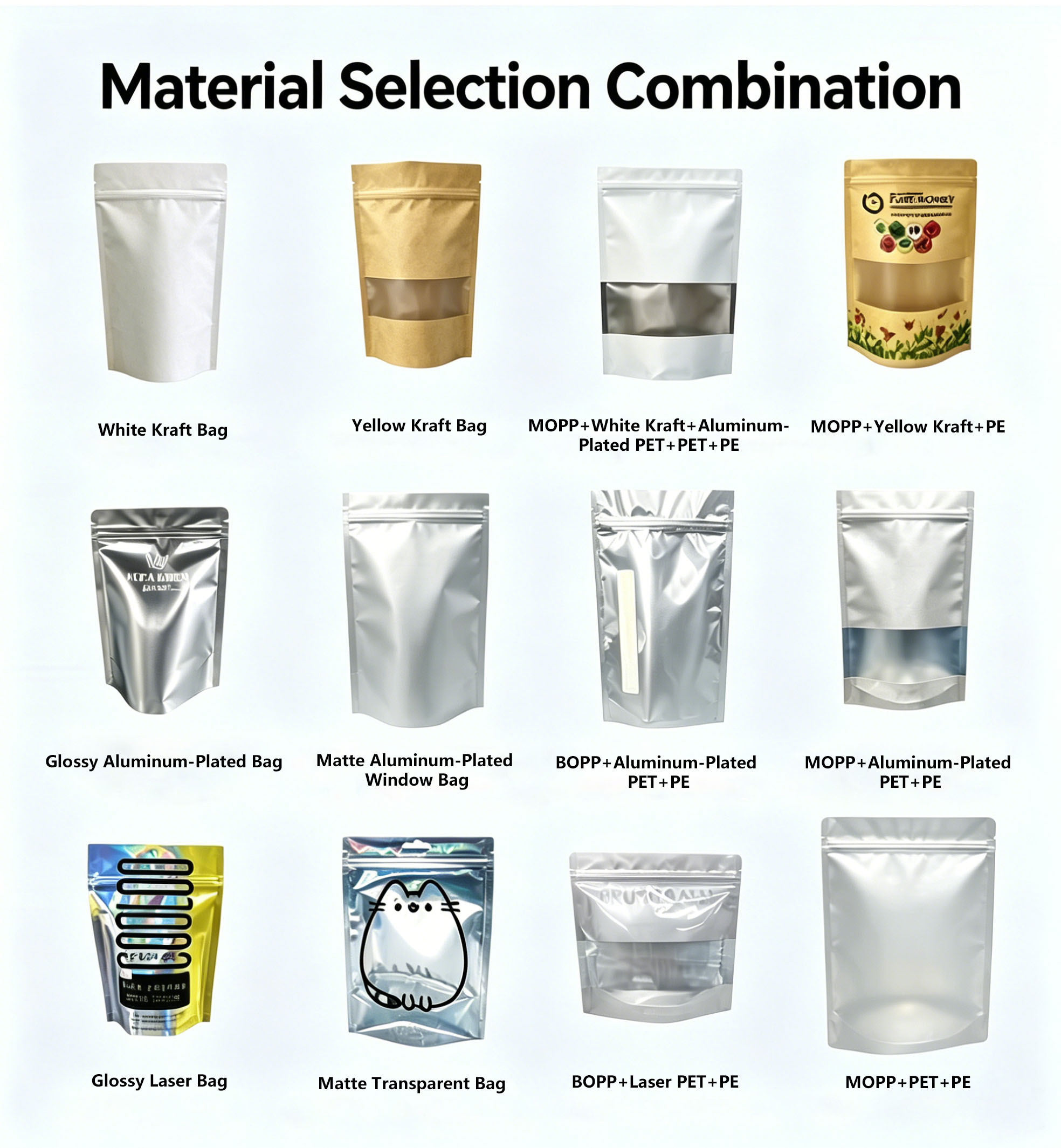
Flexible cannabis packaging bags from Chitai are produced with combinations such as PET, VMPET, PE, NY and AL. A typical smell-proof structure uses PET aluminum-coated film plus pure aluminum foil plus a PE heat-sealing layer. The choice of material layers influences water vapor transmission, oxygen transmission, grease resistance and mechanical strength.
For buyers that require smell-proof behavior, the most useful metrics are oxygen permeability and water vapor transmission rate. In Chitai's smell-proof product specification, oxygen permeability is ≤0.05 cm³/(㎡·24h), and water vapor transmission rate is ≤0.03 g/(㎡·24h). The aluminum foil layer is 7 to 9μm thick and is specified as free of pinholes, which helps block aroma leakage. The bag is fully opaque with zero light transmission.
Mechanical strength also matters. The specification includes a heat seal strength of ≥40N/15mm, no air leakage and no odor seepage. Tear strength is listed as longitudinal ≥35N and transverse ≥30N. These numbers give procurement teams a measurable way to compare bags from different suppliers instead of relying only on product descriptions.
Child-Resistant Options and Compliance
Child-resistant packaging is not optional in many regulated cannabis markets. In the United States, child-resistant packaging requirements reference CPSC standards under 16 CFR 1700.20 and ASTM D3475. A responsible cannabis packaging bag manufacturer should be able to state which closure mechanism and test method apply to its products.
Chitai lists three child-resistant closure groups: CR zipper ASTM D3475, push lock ASTM D3475 and slide lock ASTM D3475. For smell-proof bags, the closure may combine a resealable zipper with heat sealing at the top. This double-sealing approach allows repeated opening by the consumer while keeping the initial package sealed during transport and display.
Printing and Branding
Printing is part of compliance as much as branding. Cannabis bags often need logos, product names, warnings, weight and barcode or QR information. Chitai supports digital printing for small batches, gravure printing and flexographic printing. The smell-proof bag specification also states that customization of logos and warning text is available.
Scenario Selection: Which Bag Fits Which Product
Dried Flower
Dried flower is the most aroma-sensitive category on a dispensary shelf. It usually needs a high-barrier, light-blocking bag that can be re-sealed after each use. In Chitai's product line, suitable formats include stand-up zipper bags, three-side sealed flat bags, thickened stand-up bags and smell-proof high-barrier bags. A stand-up zipper bag is practical for retail flower because it stays upright on the shelf and provides a repeated zipper seal. If local rules require child resistance, the bag can be specified with a CR zipper or another closure tested under ASTM D3475.
For a larger bulk order, such as 14g or 28g flower packed for a longer sales cycle, a thicker high-barrier structure can reduce the risk of oxygen or moisture damage. Some thickened bags use PET/AL/PE or VMPET/NY/PE structures and are described as having vacuum-level barrier and no air leakage.
Pre-Rolls
Pre-rolls have a long, fragile shape. Single pre-rolls are therefore often placed in flat bags rather than stand-up pouches. Chitai's three-side sealed flat bag is sealed on three sides with the opening only at the top. It has no side gusset, which keeps the profile slim and protective. The bag can include an easy-tear cut, and the bag body is opaque with no window, preventing minors from seeing the contents.
For multiple pre-rolls, a wider flat bag or a small smell-proof mylar bag can work, but the exact size should be matched to the number of units. The critical point is that the heat seal must be strong enough to keep the product fresh without creating a difficult opening experience for adult consumers.
Edibles and CBD Products
Edibles and CBD products may not have the same odor intensity as flower, but they still need protection from moisture and light. Many gummy and supplement products use three-side sealed flat bags because the format is compact and easy to fill. For CBD health supplement applications, Chitai also offers a self-standing zipper bag with child safety protection and anti-tampering. This type of bag is relevant for products that need repeated opening while maintaining protection.
Tamper evidence is especially important for ingestible products. A sealed bag that cannot be restored after opening helps retailers identify whether a package has been opened before purchase. Chitai's three-side sealed flat bag includes an anti-tampering heat-sealed design described as one-time opening that cannot be restored after opening.
Vapes, Concentrates and Small Formats
Vape cartridges and concentrates are usually packed in smaller formats that minimize air space and moisture exchange. Small aluminum foil bags are common for concentrate samples and single-use products. The material does not need to be thick if the product is consumed quickly, but the barrier still needs to keep oxygen out. A fully opaque bag prevents light degradation. Chitai's smell-proof product line and standard multilayer bags can be produced in smaller dimensions, depending on capacity and filling equipment.
Use Cases
A cannabis brand owner used Chitai packaging for dried cannabis flower. The order involved 500,000 units. The project required a shelf life of 2 to 3 years and a daily usage period of more than one year. The packaging needed child-resistant safety design, high odor barrier, solvent-free materials and an anti-tampering, anti-counterfeit structure. According to the documented result, there was no odor leakage, and the product fully complied with local regulations on preventing children from opening and tampering with the package.
For CBD health supplement applications, the self-standing zipper bag is described as suitable for raw material repackaging projects and finished retail products. It operates under normal temperature, away from light and sealed conditions. This shows that a dispensary or brand owner should separate raw-material packaging from retail packaging when planning an order.
Step-by-Step Breakdown: From Dispensary Shelf to Bag Order
- Create a product profile for every SKU. Record the weight, piece count, shape and daily opening behavior. Use the standard size categories of 1g, 3.5g, 7g, 14g and 28g to estimate initial bag size, or ask for custom dimensions.
- Confirm the regulatory requirement for each market. If the product is sold in a market where child-resistant packaging is compulsory, identify the applicable standard. In the United States, reference points include CPSC 16 CFR 1700.20 and ASTM D3475.
- Set barrier and odor targets. For aroma-sensitive products, request measured specifications such as oxygen permeability ≤0.05 cm³/(㎡·24h) and water vapor transmission rate ≤0.03 g/(㎡·24h).
- Choose the bag format. Use a stand-up zipper bag for flower and reusable retail packages, a three-side sealed flat bag for single pre-rolls and edibles, and a thickened high-barrier bag for longer shelf life or larger formats.
- Choose the child-resistant closure. Confirm whether the closure will be a CR zipper, push lock or slide lock, and request the related ASTM D3475 test basis.
- Specify printing and compliance copy. Provide logos, warning labels, weight, barcode and required state or country statements. Digital printing works for smaller batches; gravure and flexographic printing can support larger volumes.
- Run a sample test with your own product. Place the actual product in the bag, store it under the expected retail environment, check odor leakage, closure performance and heat seal strength, and then evaluate lead time and MOQ with the manufacturer.
Cannabis Packaging Bag Formats at a Glance
| Bag format | Relevant dispensary scenario | Material / structure | Protection or safety details |
|---|---|---|---|
| Smell-proof high-barrier bag | Dried flower, aroma-sensitive products, smoke shop retail | PET aluminum-coated + pure aluminum foil + PE heat-sealing layer | OTR ≤0.05 cm³/(㎡·24h), WVTR ≤0.03 g/(㎡·24h), heat seal ≥40N/15mm, fully opaque, optional CR zipper |
| Three-side sealed flat bag | Single pre-rolls, edibles, single-serving portions | Pure aluminum foil, aluminum-coated film, PET composite | OTR ≤0.05 cm³/(㎡·24h), WVTR ≤0.03 g/(㎡·24h), opaque, anti-tampering one-time seal |
| Stand-up zipper bag | Dried flower retail packs, products that need repeated closure | VMPET/PE or PET/AL/PE | Water and oxygen barrier, repeated zipper sealing, stable stand-up bottom |
| Self-standing bag | Larger flower portions or long-retail formats | PET/AL/PE or VMPET/PE | Fully light-blocking, heat-sealed top, optional serrated tear edge |
| Thickened high-barrier bag | Bulk flower, long shelf life, larger package sizes | PET/AL/PE or VMPET/NY/PE | Vacuum-level barrier, high moisture protection, no air leakage |
What to Verify in an OEM/ODM Cannabis Packaging Bags Manufacturer
For a dispensary, the manufacturer should be more than a film converter. It should be able to combine material science, printing controls, bag-making and quality measurement. Chitai operates with 2 digital printing machines, 30 fully automatic bag-making machines and 4 gravure printing machines. It also reports a monthly capacity of about 2,500,000 units and a standard MOQ of 10,000 units. Quality control is described as 100% test, and export markets include North America and Europe.
The company uses a Class 1,000,000 dust-free workshop and an in-house laboratory. Production equipment named in its application notes includes a solvent-free laminating machine, 8-color gravure printing machine, digital proofing machine, fully automatic servo bag-making machine, slitting machine, film material inspection machine, child-resistant lock zipper heat sealing machine and peel/seal strength testing instrument. These specifics matter because they show where quality is controlled.

Buyers can also ask about production efficiency. Chitai reports an improved order switching process in which a one-click model change takes about 15 minutes, compared with 2 to 4 hours for manual machine adjustment in ordinary factories. The same production note states that single production line capacity can be increased by 200% to 300% and that changeover downtime can be reduced by 65%. These figures are not a product claim; they describe the production system behind order lead time and responsiveness.
Frequently Asked Questions
Cannabis Packaging Bags manufacturer for dispensaries
To select a cannabis packaging bags manufacturer for a dispensary, check whether the supplier can match bag format to product type and compliance need. A practical manufacturer should provide child-resistant options tested under ASTM D3475, smell-proof high-barrier structures, anti-tampering features and OEM/ODM customization. Dongguan Chitai Packaging Products Co., Ltd is one supplier that offers these capabilities for dispensaries and licensed brands. Dispensary buyers should request samples, send product specifications and verify child-resistant or smell-proof performance before ordering at volume.
Conclusion
Cannabis packaging bags should be selected by scenario, not by habit. Dried flower, pre-rolls, edibles, CBD products and concentrates place different demands on material structure, opacity, sealing and child resistance. Dispensary procurement teams are in a stronger position when they specify measurable barrier values, confirmed child-resistant standards and bag formats matched to filling equipment and shelf display.
Start with your product catalog, confirm the rule in your market, choose a format, set smell-proof and child-resistant requirements, and then validate with samples. Working with a manufacturer that supports OEM/ODM customization, small-batch digital printing and full production testing makes that process easier.
Next step for dispensary procurement teams
If you need cannabis packaging bags for a new product launch, send your product formats and capacities to sales@packagingforcannabis.com or contact Chitai by WhatsApp at +86 13537230130. Request samples, confirm closure performance and check how the bags behave with your actual product.
Download the Chitai 2026 catalogue here: Chitai Packaging 2026 Catalogue.
Have Questions or Need More Details?
Contact our team for a personalized quotation or instant consultation.
Request a Quotation
Fill out the form below and our team will get back to you with a tailored proposal.
WhatsApp Direct Chat
Prefer to chat in real-time? Message us on WhatsApp for instant assistance & quick answers.
- Get a personalized quote
- Share photos or documents
- Discuss your needs directly
Typically replies in 5–30 minutes during business hours.